There’s a particular kind of loneliness that comes with realizing the places, people, and versions of yourself you once considered permanent no longer exist in quite the same way.
Sometimes the change happens gradually.
A friendship begins to feel unfamiliar. A city loses the possibilities it once seemed to promise. The person you imagined becoming starts to feel increasingly distant from the person you actually are.
Other times, everything changes in a single moment.
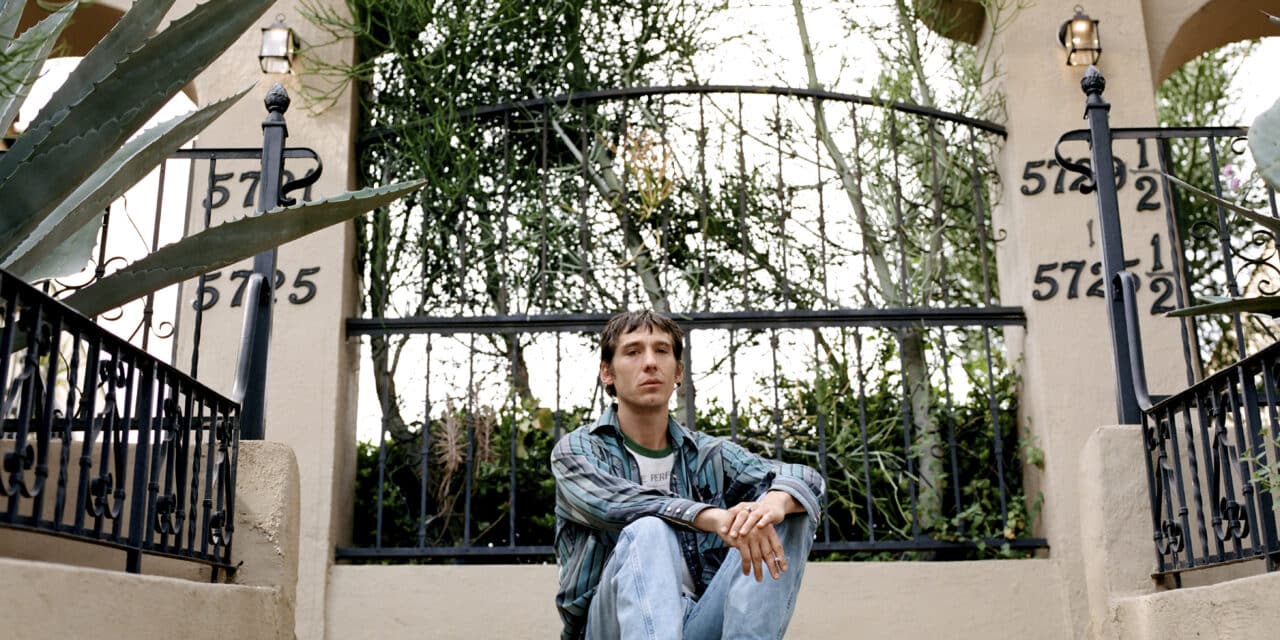
For Palestinian-American singer-songwriter Sam Burton, both kinds of transformation inform his third solo album, Fairweather Friend, arriving October 30 through his new label home, Captured Tracks.
The record follows a period marked by a serious touring accident, the dissolution of a musical project, shifting relationships, and the emotional consequences of trying to rebuild a sense of identity after circumstances have fundamentally changed.
But rather than turning those experiences into a straightforward narrative of recovery, Burton approaches them with something more complicated: an understanding that personal growth often requires accepting losses that cannot be undone.
His music has always existed somewhere between hope and melancholy, drawing from the traditions of folk songwriting while resisting the idea that emotional resolution must necessarily arrive by the end of a song.
On Fairweather Friend, that tension becomes especially pronounced.
There’s a quiet confidence in Burton’s willingness to leave certain questions unanswered.
And perhaps that’s what makes the album feel like such a significant turning point.
Not because he has finally figured everything out, but because he seems increasingly comfortable with the possibility that he never will.
When Survival Changes Everything
The story behind Fairweather Friend begins with an experience that could have ended very differently.
While touring with a band he played in during and after the pandemic, Burton was involved in a serious car accident.
He had been driving, although the accident wasn’t his fault.
He and his bandmates survived, but the experience left him struggling with guilt and confronting the emotional weight of what had happened.
In the aftermath, the musicians found themselves relying on one another through a shared process of recovery.
The experience deepened their relationships, creating a sense of connection rooted in gratitude, vulnerability, and the knowledge of how easily everything might have been lost.
But that period of closeness was followed by another unexpected change.
The project eventually dissolved.
Some relationships ended, others began, and Burton found himself moving into a new phase of his career.
The contradiction is striking.
An experience that brought a group of people closer together was followed by the loss of the creative structure that had connected them.
It’s the kind of emotional complexity that rarely lends itself to easy conclusions.
Sometimes people help one another survive something extraordinary without necessarily remaining part of each other’s lives forever.
Sometimes gratitude and grief coexist.
And sometimes the relationships that shape us most profoundly are precisely the ones we cannot preserve.
These tensions became part of the emotional landscape Burton would eventually explore through his new songs.
The Strange Experience of Becoming a Stranger
The album’s lead single, “I’m A Stranger,” offers perhaps the clearest introduction to Burton’s state of mind.
Produced by Jonathan Wilson, the song occupies the uncertain territory between memory and alienation.
Burton describes it as an emotional impression rather than a definitive statement.
“The song sits somewhere between nostalgia and alienation,” he explains. “It’s more of a feeling than a statement. There is no home to go back to.”
That final observation carries particular weight.
Home is often treated as something stable: a physical location, a community, or a collection of memories that remains available whenever we need reassurance.
But what happens when the place you remember no longer exists in the form you remember it?
Or when you return to a familiar environment only to discover that you’ve changed too much to experience it the same way?
For Burton, Los Angeles became a setting for precisely that kind of reckoning.
After extensive touring, he returned to the city and began reflecting on how differently it felt compared with his younger years.
“I think a lot of things were changing, including the way LA used to feel for me when I was young and I felt like I could do anything,” he recalls.
The seemingly limitless possibilities of youth had given way to something more complicated.
“It felt like certain doors were closing. But the growth was inspiring to me. And I liked that.”
It’s an unusually revealing admission.
The recognition that certain opportunities or identities are no longer available can be painful.
Yet Burton doesn’t describe that realization exclusively as a loss.
There’s also something liberating about accepting the limitations that emerge with age.
The disappearance of one imagined future can create space for another.
And perhaps the most difficult part of growing older isn’t losing the person you once were.
It’s learning not to confuse that loss with failure.
The Solitude of Northern California
After returning to Los Angeles and beginning to write again, Burton spent several months working on a farm in Northern California, near Humboldt.
Away from the rhythms of touring and the expectations of the music industry, he found himself immersed in long days of work, solitude, and songwriting.
It was there that he wrote nearly half of Fairweather Friend.
The environment offered an opportunity to reconsider not only his music but also his relationship with himself.
Burton describes the period as an attempt to find the part of his identity he had often located in other people.
It’s an idea that speaks to a familiar emotional tendency.
We frequently understand ourselves through our relationships.
Through the people who recognize us, the communities that give us belonging, and the shared experiences that help define our lives.
But when those relationships change or disappear, the identities built around them can become unstable.
Burton’s time in Northern California appears to have created room for a different kind of self-examination.
Rather than looking outward for reassurance, he began turning inward.
The experience also influenced his approach to songwriting.
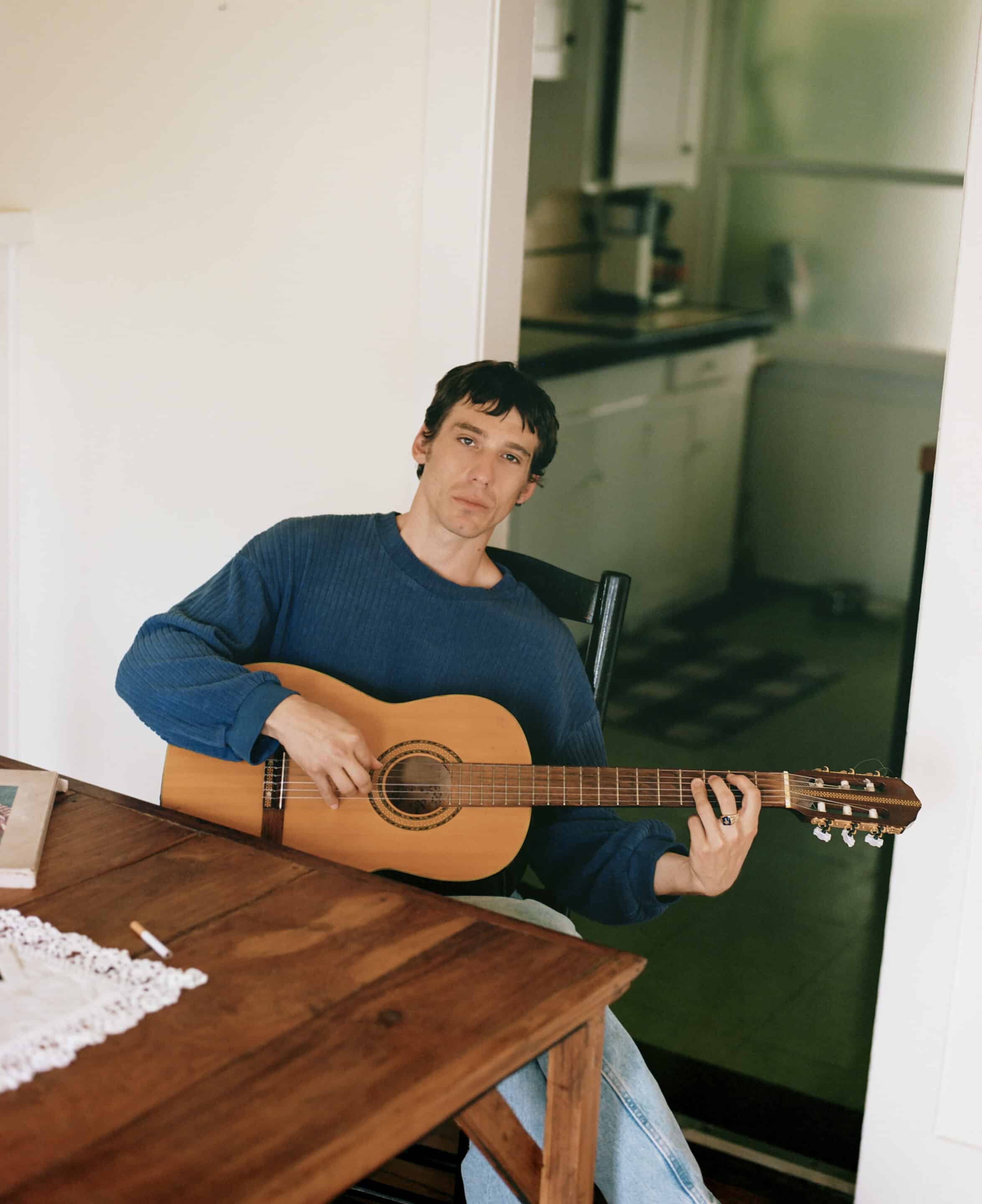
Having spent considerable time performing stripped-down solo sets for larger audiences, Burton began thinking more deliberately about how songs could exist without the support of a full band.
He studied solo performances by musicians including Neil Young and Bert Jansch, focusing on the expressive possibilities of guitar playing and the relationship between a performer and an audience.
The result was a renewed emphasis on musical intimacy.
Not necessarily simplicity for its own sake, but an understanding that a song should be able to communicate something essential even when stripped of elaborate production.
That philosophy would become central to the album’s recording process.
Finding Community in the Recording Studio
Despite the solitude that informed much of its writing, Fairweather Friend is also a record shaped by collaboration.
Burton initially returned to the studio with Jonathan Wilson, the producer and musician known for his work with artists including Father John Misty and Conor Oberst.
Wilson had previously produced Burton’s album Dear Departed, making their reunion a continuation of an established creative relationship.
The sessions followed Burton’s preference for recording songs live, preserving the interaction and spontaneity of musicians performing together.
But after completing that initial work, Burton felt compelled to revisit some of the material.
With Wilson occupied by other commitments, he gathered his bandmates at Recorders, drummer Pierce Gibson’s studio in Echo Park.
There, the musicians re-recorded a portion of the album without an outside producer.
Burton and the band directed and arranged the sessions themselves.
The decision carried emotional significance beyond the practicalities of recording.
After the accident, the dissolution of his previous project, and the uncertainty that followed, Burton was once again making music within a community of musicians he trusted.
The sessions reflected the same spirit of mutual support that had helped him navigate an earlier period of crisis.
Yet this time, the collaboration existed within a different framework.
Burton was no longer simply searching for a sense of belonging through the people around him.
He was bringing a more developed understanding of himself into the creative process.
The resulting album combines the perspective of a songwriter who has spent considerable time alone with the energy of musicians discovering something together.
It’s a reminder that independence and collaboration aren’t necessarily opposites.
Sometimes knowing yourself more clearly makes it possible to connect with others more honestly.
Folk Music as a Language for Uncertainty
Burton’s music is frequently described as folk, and the influence of the genre’s great singer-songwriters is evident in the traditions he draws upon.
His work recalls the emotional directness and literary sensibilities associated with artists such as Fred Neil, Bob Dylan, Nick Drake, and Leonard Cohen.
But categorizing Burton solely as a folk musician risks overlooking what makes his songwriting compelling.
His songs are less concerned with reproducing a particular musical era than with exploring the psychological territory those artists helped make possible.
They are songs about memory, longing, contradiction, and the ways people construct meaning from experiences they don’t fully understand.
What distinguishes Burton’s approach is his willingness to acknowledge that certain losses remain irretrievable.
Not every relationship can be repaired.
Not every version of the past can be revisited.
And not every emotional wound becomes a lesson that neatly justifies the pain that preceded it.
That doesn’t mean the music is without hope.
On the contrary, hope seems to exist precisely because Burton refuses to deny the reality of loss.
His songs suggest that meaning doesn’t require everything to work out.
Sometimes meaning comes from continuing to create despite knowing that certain things cannot be recovered.
It’s a perspective that feels particularly resonant in a cultural environment where personal transformation is often presented as a linear journey toward self-improvement.
Burton’s music offers something less polished and potentially more truthful.
Growth can be confusing.
Healing can be incomplete.
And becoming more comfortable with yourself doesn’t necessarily make the world feel less uncertain.
The Compulsion to Keep Creating
Perhaps the most revealing thing Burton has said about his artistic identity is also one of the simplest.
“I’m really just doing this because I have a compulsion to do it.”
He continues: “And I have found wholeness—or something that felt like wholeness—doing it my whole life.”
The distinction between wholeness and something that merely feels like it is important.
Burton doesn’t claim that music has resolved every contradiction in his life.
Instead, it appears to offer a way of living with those contradictions.
Songwriting becomes less a means of arriving at a final answer than an ongoing process of understanding what it means to exist amid change.
That perspective also helps explain the significance of Fairweather Friend as his third solo album.
The record doesn’t announce a dramatic reinvention.
It documents an artist becoming more deeply committed to the instincts that have guided him all along.
The difference is that those instincts are now informed by experiences that have challenged his assumptions about identity, connection, and permanence.
His signing to Captured Tracks marks an important professional development, but the album’s central achievement appears to be more personal.
Burton has reached a point where he can acknowledge the closing of certain doors without interpreting it as the end of possibility.
And in that acceptance, he seems to have discovered a different kind of creative freedom.
Learning to Live Without the Promise of Return
There’s something quietly radical about making music that doesn’t promise resolution.
So much of contemporary storytelling depends on the idea that pain must eventually produce clarity.
That every difficult experience should make us stronger.
That every ending should prepare us for a better beginning.
But life rarely follows such a convenient structure.
Sometimes we lose people we still love.
Sometimes we outgrow places we once considered home.
And sometimes we continue searching for something without knowing exactly what it is.
On Fairweather Friend, Sam Burton doesn’t attempt to eliminate those uncertainties.
He allows them to become part of the music.
The album’s emotional power lies in its recognition that accepting change doesn’t require pretending the past no longer matters.
You can grieve something and still be grateful for what it gave you.
You can recognize that a chapter has ended without wishing it had never happened.
And you can move forward without knowing whether the place you’re going will ever feel like home.
For Burton, the act of songwriting appears to be what makes that movement possible.
It’s a practice that has accompanied him through different relationships, cities, creative communities, and versions of himself.
And even as those circumstances continue to change, the impulse to create remains.
Perhaps that’s the closest thing to permanence any artist can reasonably hope for.
Not the promise that nothing will ever be lost.
But the knowledge that, even after losing something essential, there may still be another song waiting to be written.
Fairweather Friend — Tracklist
- Fairweather Friend
- After Days Slip Away
- I’m A Stranger
- Lilac Man
- Tomorrow Takes A Dream To Find
- Picture People
- Before Waking
- Free Again
- Light Gone Away
- Start Over
- Do You Still Know Your Man
Release date: October 30, 2026
Label: Captured Tracks
Production: Jonathan Wilson, with additional sessions directed and arranged by Burton and his band.
Listen and watch: “I’m A Stranger” official video
Upcoming UK and European Tour
Following his North American dates supporting Aldous Harding, Burton joins Widowspeak for a series of November performances:
- November 12 — Leeds, UK — Brudenell Social Club
- November 13 — Dublin, Ireland — Workman’s Club
- November 15 — Glasgow, UK — The Rum Shack
- November 16 — Manchester, UK — YES (Pink Room)
- November 17 — London, UK — Scala
- November 18 — Lille, France — La Bulle
- November 19 — Paris, France — Le Pop-Up!
Photography by Jacob Boll.
In Conversation With Sam Burton
MUNDANE: Fairweather Friend feels like an album born from survival rather than simply inspiration. How did living through such a life-altering accident change not only your perspective on music, but on what it means to create with intention?
Sam Burton: Surviving the accident made me feel incredibly lucky to not have killed anyone, including myself. It felt like a kind of miracle because it really was down to very small details and timing that nobody died.
The accident was this event that caused a large chain of events in my life that brought a lot of change. The record is not about the accident, but it feels connected to the relationships I made and lost around it, and it felt like the ending of a chapter.
So when I thought about how I’d changed and experienced change in my life, the accident felt like the point that could contextualize all of that.
I wouldn’t say it changed my perspective on music or my intention, but it was reflected on and became a part of the songs. Not all of it was conscious at the time, but the experience gave me some questions that lived inside of me after that.
MUNDANE: Across songs like “I’m A Stranger,” “After Days Slip Away,” and “Fairweather Friend,” there’s a recurring tension between leaving, returning, and realizing that neither you nor the places you once called home are quite the same. How much of this record is about trying to understand what “home” means after time and distance have changed your relationship to it?
Sam Burton: The places change and we change. What was once a home to me is not now because that me doesn’t exist anymore. Sometimes the realization of that can feel painful, sometimes it can be liberating. Nothing is fixed about it.
I do think part of the record was me learning to find that home within myself and not in other people and places, and it’s also about my resistance to do that because part of that can feel like being exiled.
I think the idea of home to me is always changing. Right now it feels like a feeling of purpose and when that purpose is mirrored back to you.
Can we really love anything or anyone if we don’t live out our heart? Can we ever be home if our heart isn’t known to us? What if our heart leads us away from everything we love?
Sometimes we are the closest to home being truly lost.
MUNDANE: This record was made partly with Jonathan Wilson and partly through a deeply collaborative process with your own band. How did moving between those two creative environments influence the emotional character of the album?
Sam Burton: It was an honor to go back to Jonathan’s again, and at the end, when I felt like I didn’t quite have everything, it ended up being a gift because I was able to try recording with my touring and live band at Pierce Gibson’s new studio, Recorders.
That process was so fun for me. I loved how it sounded, and we all got to record live in a room together. I could have tracked songs with them like that for weeks if I was able to.
With Jonathan, he was doing me a favor, and I felt some pressure to get out of his hair and finish up. Not that it wasn’t a good time, but he was building his house and had just had a baby, so I wanted him to be free again.
With my friends, it really just felt like it usually does when we are just having fun playing music. I think that was captured a bit in the recordings, but I have no idea if that will translate to a listener.
It also taught me that I could make records that way now, which was an enormous relief to me because funding may not, and most likely will not, always be available for someone like me.
MUNDANE: Spending time working on a farm in Northern California sounds like the opposite of the modern music industry. What did solitude, routine, and physical work teach you about songwriting that life on the road never could?
Sam Burton: Well, I only spent a month there, but I have done it multiple times, so in a way it’s multiple months.
I just want to say that I do think any lifestyle can be a teacher. For me, being out there in the quiet, in a very beautiful natural environment that I personally really connect with, allowed me to feel peaceful and explore myself more deeply.
I had vivid dreams, and I would get inspired by small things like the way the moon looked or the sound of water.
Even when I’m bussing tables, if I’m in a flow with it, I would get reflective and inspired, so working in the garden would let my mind wander in a way that felt good.
Whenever I go there, I just try to let whatever comes up come up, and I try and trust it rather than settle on something I want to write about, even if at first it only comes up as a feeling or an image that I don’t understand.
MUNDANE: Your music has often been described as folk, but your songs feel less tied to genre than to emotional honesty. Do you think labels can sometimes distract listeners from what a song is actually trying to say?
Sam Burton: I think that most people relate to music in a personal way that transcends the label.
I think the labels mostly serve to point people in the general direction of what they might be looking for, so they don’t bother me.
Do they actually capture the essence of the music? No. But neither do detailed reviews or books.
If the music is good, it contains some kind of mystery because it shows us something that lives in us. If it could be captured, it would die.
MUNDANE: Throughout Fairweather Friend, there’s a recurring tension between accepting loss and continuing to move forward anyway. Have you found that healing is more about letting go—or learning to carry certain experiences differently?
Sam Burton: I really don’t know. I feel like that’s a question I’m living with right now. It’s probably a bit of both.
You have to let yourself change and allow other people to change too.
What does it mean to carry something differently? Sometimes it’s that you realize that something that initially caused grief and instability served you in a way.
But how can you carry it differently until you live through that and it arrives as truth?
We can accept loss if we have hope and faith for the future.
When I was younger, I felt faith and hope in feeling my “destiny” and my potential and future.
Now I feel it from being connected to life in smaller, humble ways, and because of that it’s harder to do them, especially when I don’t feel great.
I’m just trying to be honest to show it isn’t always easy to move on. For anyone reading this, I’m not trying to be pitiful.
MUNDANE: After years of performing with bands, you began writing these songs with solo performance in mind. How did stripping everything back to just your voice and guitar change the way you approached storytelling?
Sam Burton: After I did a bunch of solo and stripped-down tours, I realized the songs on Dear Departed didn’t translate well in that arrangement.
So I wanted to write some songs for the next record that hopefully could survive in any arrangement because it’s so hard and expensive to bring a band on tour.
So that didn’t change the way I thought about the lyrics or the storytelling; it just had to do with how the song was played.
MUNDANE: As a Palestinian-American artist, identity inevitably exists somewhere beneath the surface of your work, even when it isn’t explicitly addressed. How has your understanding of belonging evolved throughout the making of this record?
Sam Burton: I am not from Palestine, I was born here, so I’m not really somebody that can really comment on this question in this context.
I don’t really know what it means to be a Palestinian-American. I just mentioned to my bio writer that my dad and his side of the family all live there and so I’m half, and that’s how they chose to write about me.
What I will say is I believe the world is with Palestine and they are showing that. The world wants human beings to be free and not continually oppressed, enslaved, and murdered for the profit of a few.
Those in power ignore the people of the world and wage war against us.
How does someone’s sense of belonging change when their whole family is killed and their house is blown to bits?
Well, in Palestine I’ve seen that their faith in God has deepened and in turn their sense of belonging.
They are the strongest people in the world in my eyes.
MUNDANE: You once said that making music is something you feel compelled to do rather than simply choosing to do. Has that compulsion changed over the years, or has it become even stronger as life has become more complicated?
Sam Burton: It waxes and wanes for me.
Sometimes I have to remember that I get something out of going to that place, so I make myself do it.
If I’m at peace with myself, the compulsion to do it is often.
Look at kids: they always want to draw and sing and dance or whatever. It’s all the same thing, and it never leaves us, but our lives sometimes make it feel far away or impossible or so loaded with history, betrayal, and failure that it’s too painful to keep doing things the same way.
I still want to make music, and I still am in love with it.
MUNDANE: Fairweather Friend feels like an album about accepting that some chapters don’t end with neat resolutions. If listeners take one thing away from this record, what do you hope they discover about resilience, connection, and finding peace in the unknown?
Sam Burton: Really, all I would ever want from anyone listening to my music is to enjoy it as music.
I don’t expect anybody to discover emotional truths in it or anything like that.
If I read a book about heartbreak, do I know something about love if I’ve never lived it?
Maybe if someone relates to it, the record could be a balm to them, but that’s not something I’m hoping for.
It’s hard to find peace in the unknown if you don’t get to know yourself, and that process is lifelong.