
For nearly three decades, Chus & Ceballos have treated rhythm as something larger than genre.
Long before Afro House, Organic House, and Latin-inflected club music became global movements, the Spanish duo were already building a language around tribal percussion, rolling grooves, soulful textures, and a distinctly Iberian sense of movement. That sound would eventually become known as the Iberican Sound, a framework that helped place Spain firmly on the global electronic map while influencing generations of DJs and producers.
Now, after a five-year hiatus that began during the pandemic, the duo have returned not simply to revisit what made them successful, but to understand what that shared musical language means in the present.
Their new single “Somos Uno” is the first original release of this renewed chapter.
The title translates to “We Are One,” but the message operates on several levels at once. It reflects the duo’s reunion, the relationship between Latin traditions and global electronic music, and the communal energy of a dancefloor where identity can momentarily become secondary to rhythm.
“This first release means far more to us than simply putting out a new record,” Chus & Ceballos explain. “It’s our way of returning to the studio, rediscovering the creative chemistry that always defined us, and reconnecting with the sound that became part of our identity.”
That chemistry appears to have survived the separation intact.
The five years apart allowed both artists to develop independently, but when they returned to the studio, the process did not feel like rebuilding something lost.
It felt like continuing a conversation.
“The chemistry had never disappeared,” they say. “It had simply evolved.”
That distinction is important because Somos Uno does not function as nostalgia.
Its foundations are recognizable: deep tribal percussion, hypnotic repetition, organic textures, and the rolling physicality that has always defined the duo’s work. Yet the production feels contemporary, reflecting the global expansion of Latin electronic music and the increasingly fluid relationship between house, techno, Afro-influenced rhythms, and organic club music.
The record’s spoken message becomes its emotional center.
Rather than operating as a decorative vocal sample, the speech transforms the track into a statement about community and shared humanity. For Chus & Ceballos, that message extends beyond club culture.
“We wanted our first record together after five years to stand for something beyond music,” they explain. “Unity, respect, diversity, and shared humanity.”
The timing feels especially appropriate.
Their Reunion Tour has already taken them through more than 50 cities, reconnecting with longtime supporters while introducing the Chus & Ceballos sound to listeners who may have discovered electronic music long after the Iberican Sound first emerged.
What they found was not merely nostalgia.
There was hunger.
“There’s a genuine emotional connection at these shows because many people never imagined they’d see us performing together again,” they say. “At the same time, we’re seeing an entirely new generation discovering Chus & Ceballos for the first time.”
That intersection—memory and discovery, legacy and possibility—is where Somos Uno lives.
We spoke with Chus & Ceballos about their reunion, watching Latin electronic music become global, protecting authenticity over nearly three decades, and why a dancefloor can still become one of the rare spaces where difference gives way to connection.
After a five-year hiatus, Somos Uno feels less like a comeback single and more like a statement of purpose. What did reconnecting in the studio reveal about your creative chemistry?
Chus & Ceballos: The five years apart gave us perspective.
During that time, we both evolved individually, explored different ideas, and matured as artists.
When we met again in the studio, we immediately realized that the chemistry had never disappeared. It had simply evolved.
There was no need to force anything. Ideas flowed naturally, just as they always had.
Somos Uno wasn’t conceived as a comeback record.
It became a reflection of who we are today: two artists with different experiences who still share the same musical language and the same passion for creating music that connects people.
You pioneered the Iberican Sound long before Latin influences became central to global electronic music. How does it feel seeing the wider industry embrace ideas you have championed for decades?
Chus & Ceballos: It is incredibly rewarding.
Back then, incorporating Latin percussion, tribal rhythms, and organic influences into house music wasn’t following a trend. It was simply an honest expression of our cultural identity and musical roots.
Today, hearing those elements across the global electronic scene is something we genuinely celebrate.
Music constantly evolves through shared influences, and it is inspiring to see younger generations reinterpret those sounds in their own way.
We have never been interested in nostalgia.
We are excited to keep pushing that evolution forward.
Somos Uno carries a message of unity that reaches beyond the club. Do you think dance culture can still bring people together in ways few other spaces can?
Chus & Ceballos: Absolutely.
Dance music has always been about inclusion.
Once you are on the dancefloor, labels disappear.
Nationality, language, religion, or background do not matter anymore. Everyone shares the same rhythm.
That idea became the heart of Somos Uno.
We wanted to remind people that music remains one of the few universal languages capable of creating genuine human connection.
It is a simple message, but perhaps more important today than ever before.
You have managed to balance underground credibility with international success. How have you evolved with electronic music without losing what makes Chus & Ceballos recognizable?
Chus & Ceballos: We have always followed our instincts rather than trends.
Electronic music constantly reinvents itself, and that is one of the reasons we love it.
But while production techniques and sounds evolve, authenticity never goes out of style.
Our identity has always been built around groove, percussion, emotion, and musicality.
Those foundations remain the same today.
We embrace new influences, but only when they genuinely resonate with us.
Stereo Productions has become one of electronic music’s most respected labels. What role has the label played in shaping both your careers and Spain’s international electronic identity?
Chus & Ceballos: Stereo Productions has always been much more than a record label for us.
It has been a platform for ideas, creativity, and artistic freedom.
From day one, our goal was not simply to release records, but to build a community around a distinctive musical vision.
Over the years, we have had the privilege of introducing incredible artists from around the world while also helping showcase Spain’s contribution to electronic music internationally.
Seeing Stereo celebrate 25 years is something we are incredibly proud of because it reflects the dedication of everyone who has been part of that journey.
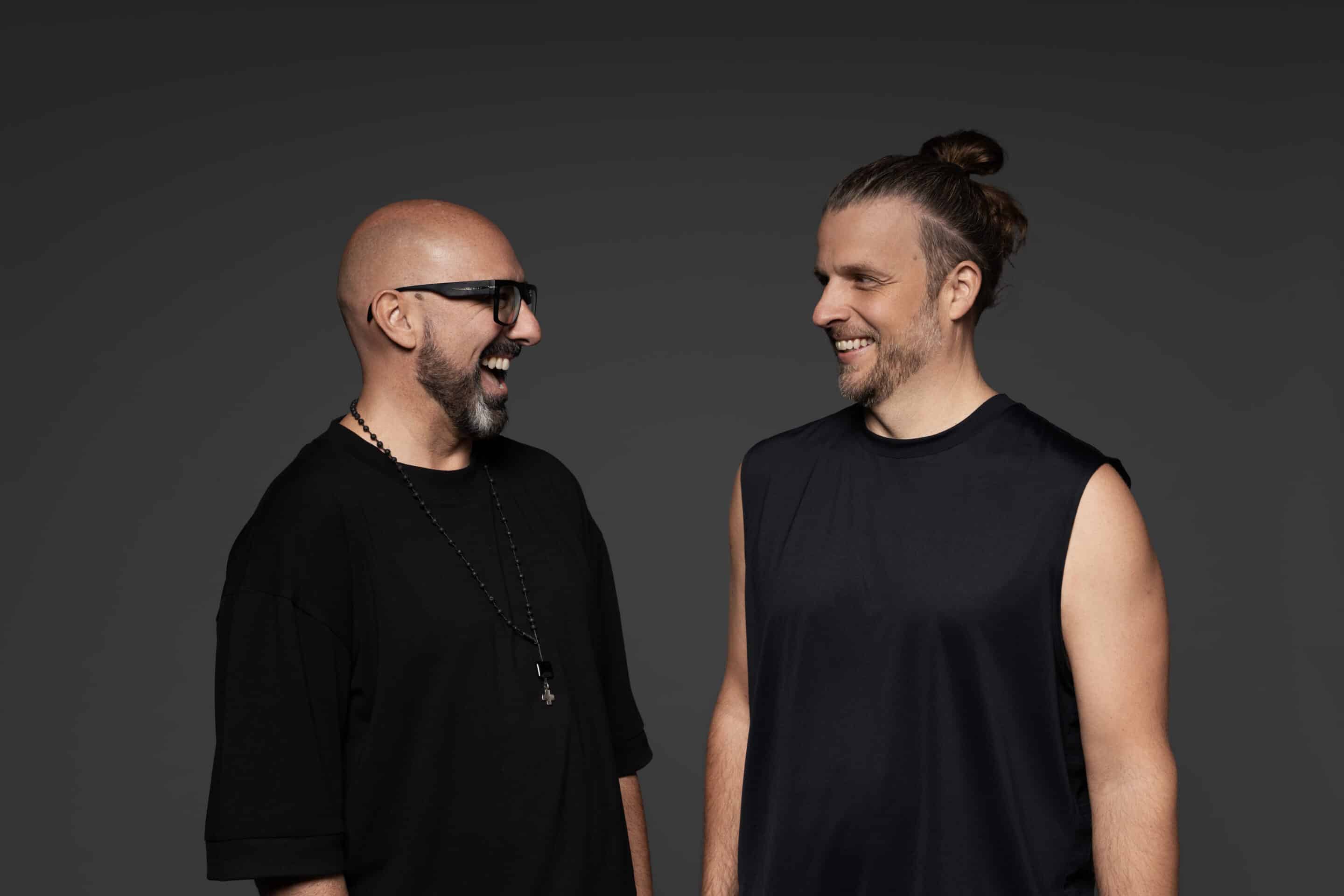
The Reunion Tour has already taken you across more than 50 cities. Has the audience response changed the direction of your new music?
Chus & Ceballos: Without question.
The response has honestly exceeded every expectation we had.
There is a genuine emotional connection at these shows because many people never imagined they would see us performing together again.
At the same time, we are seeing an entirely new generation discovering Chus & Ceballos for the first time.
That combination of nostalgia and fresh energy has been incredibly inspiring and has definitely influenced the music we are making.
We want to create records that respect our legacy while feeling completely relevant for today’s dancefloors.
Your marathon sets blend house, techno, tribal percussion, and Latin grooves. When you build a set today, are you telling a story, creating a ritual, or chasing something else?
Chus & Ceballos: Probably all of the above.
A great DJ set should feel like a journey rather than a sequence of tracks.
We pay close attention to tension, dynamics, and emotion because every crowd has its own personality.
For us, percussion has always been the heartbeat of that experience.
When people stop thinking and surrender to the rhythm, that is when something special happens.
Those are the moments we are always searching for.
The spoken message in Somos Uno transforms the track into something more than a club record. Why was that message necessary for this new chapter?
Chus & Ceballos: We wanted our first record together after five years to stand for something beyond music.
The spoken message represents values we have believed in throughout our entire careers: unity, respect, diversity, and shared humanity.
After everything the world has experienced in recent years, it felt like the perfect moment to remind ourselves that we are far stronger when we come together than when we focus on what separates us.
That is the real meaning behind Somos Uno.
Many younger producers look to your work as a blueprint for blending organic instrumentation with electronic production. What advice would you give them?
Chus & Ceballos: Study the music that inspires you before trying to reinvent it.
Understand its history, its culture, and the people behind those sounds.
Authenticity comes from respect, not imitation.
At the same time, do not be afraid to experiment.
Innovation happens when tradition meets your own personality.
Technology gives producers incredible tools today, but the emotional connection still comes from having something genuine to say.
After almost three decades, what excites you most about this new era, and what do you hope people discover through Somos Uno?
Chus & Ceballos: This feels less like looking back and more like opening a completely new chapter.
We are more motivated than ever because we are creating music without expectations, only with passion and experience.
We hope longtime supporters recognize the essence that has always defined Chus & Ceballos, while new listeners discover that dance music can be both powerful and meaningful.
If Somos Uno inspires people to dance, connect, and remember that music has the power to unite us, then we have achieved exactly what we set out to do.
There is an interesting paradox in talking about Chus & Ceballos as pioneers.
The word naturally directs attention backward.
It encourages retrospective thinking, asking where a movement started, who introduced which rhythm first, and which records eventually became blueprints for what followed.
Yet Somos Uno is compelling because Chus & Ceballos appear far less interested in proving historical ownership than in participating in what those ideas have become.
They helped establish a vocabulary.
Now that vocabulary belongs to a global conversation.
Latin percussion, tribal grooves, organic textures, and African diasporic rhythmic traditions have become increasingly visible across international electronic music. Sounds that once occupied specialized corners of house culture now move through festival stages, underground rooms, streaming playlists, and global pop.
Chus & Ceballos could approach that shift defensively.
Instead, they describe it as rewarding.
Their answer reveals an important distinction between influence and possession.
The Iberican Sound emerged from cultural exchange from the beginning. It was not created in isolation, but from Spanish identity meeting Latin traditions, house music, techno discipline, tribal percussion, and international club culture.
Its continued evolution therefore requires new artists to alter it.
Reinterpretation is not corruption.
It is evidence that the language remains alive.
This may explain why “authenticity” becomes such an important word throughout the conversation.
Chus & Ceballos do not define authenticity as maintaining one fixed sonic formula.
Their records have evolved continuously.
Production technologies change.
Tempos change.
Dancefloors change.
Audiences change.
What remains constant is the emotional architecture beneath those decisions: rhythm, musicality, groove, percussion, and connection.
Identity is therefore located less in a specific kick drum or production technique than in intention.
That philosophy also explains their advice to younger producers.
“Understand its history.”
It is a simple instruction with significant implications.
Electronic music has always existed through borrowing, sampling, reinterpretation, technological mutation, and cultural exchange. But when sounds travel globally, context can disappear.
A percussion pattern becomes a preset.
A regional rhythm becomes a production trend.
A cultural form becomes an aesthetic category inside software.
Studying the history behind those sounds restores something essential.
It acknowledges that music is not merely sonic information.
It comes from people.
Communities.
Places.
Rituals.
Migration.
Political histories.
Celebration.
Resistance.
Once that context is understood, experimentation becomes richer rather than more restrictive.
This is also where the word “uno” acquires greater meaning.
Unity does not mean sameness.
A dancefloor works because different people are responding to one pulse while remaining different people.
The goal is not to erase identity.
It is to create a shared experience strong enough to hold multiple identities simultaneously.
House music has always carried this possibility.
Its foundational spaces were built around communities frequently marginalized elsewhere. Clubs became temporary worlds where new relationships to gender, sexuality, race, class, and belonging could become possible.
Chus & Ceballos’ emphasis on inclusivity belongs to that history, even as their own musical language approaches it through Iberian and Latin cultural experience.
“Once you’re on the dancefloor, labels disappear,” they say.
That idea could sound utopian if interpreted too literally.
A club cannot eliminate the social realities waiting outside.
But for several hours, it can demonstrate another possibility.
People who do not speak the same language can understand the same transition.
A percussion break can reorganize thousands of bodies without explanation.
A DJ can create tension, suspension, and release across people who may have nothing else in common.
That is not political transformation by itself.
But it is a powerful demonstration of collective synchronization.
And for Chus & Ceballos, percussion is the mechanism through which that synchronization happens.
Calling percussion “the heartbeat” of their sets is more than metaphor.
Rhythm is the most physically direct component of the music. Melody can be analyzed. Lyrics can be interpreted. A low-frequency pulse bypasses much of that intellectual processing and enters through the body.
This is why their marathon sets become ritualistic.
Duration matters.
The longer a set unfolds, the less it feels like consuming individual tracks and the more it begins functioning as environment.
People lose track of beginnings and endings.
Records become passages.
Transitions become narrative.
The DJ stops behaving like someone presenting songs and becomes responsible for maintaining collective momentum.
Chus & Ceballos have spent decades developing that sensitivity.
Returning after five years meant discovering whether it remained.
The Reunion Tour gave them the answer.
Longtime fans arrived carrying memory.
New listeners arrived without it.
That combination created a useful pressure.
The duo could not simply recreate an earlier era because part of the audience had never experienced it.
At the same time, abandoning the musical qualities that made the reunion meaningful would betray the listeners who had waited years for their return.
Somos Uno finds the balance by refusing to distinguish sharply between past and future.
The percussion carries history.
The production carries the present.
The message points toward what comes next.
That combination also mirrors Stereo Productions itself.
A record label that survives 25 years cannot remain merely a distribution mechanism. Its significance comes from continuity and community.
Stereo provided Chus & Ceballos with the autonomy to develop an idea before the wider market necessarily understood it.
More importantly, it became a space where that idea could expand beyond the duo.
Scenes are rarely created by individual artists alone.
They require networks.
Labels.
Promoters.
Clubs.
DJs.
Designers.
Listeners.
Local communities that give a sound enough repetition to become recognizable.
Stereo helped turn an artistic instinct into an ecosystem.
That ecosystem eventually became internationally visible.
Now the duo return at a moment when many of the principles they championed are more commercially relevant than ever.
There would be an obvious temptation to capitalize on that history by presenting themselves as elder statesmen defending a legacy.
Instead, their answers repeatedly turn toward curiosity.
They want new influences.
New listeners.
New records.
New dancefloors.
They speak about almost three decades of experience without sounding finished.
That may be the most important thing about Somos Uno.
The reunion matters emotionally, but the song refuses to make reunion itself the destination.
Two paths have become one again.
The question is where they go next.
For Chus & Ceballos, the answer remains the same as it was at the beginning:
Follow the rhythm.
Build the connection.
Keep moving.