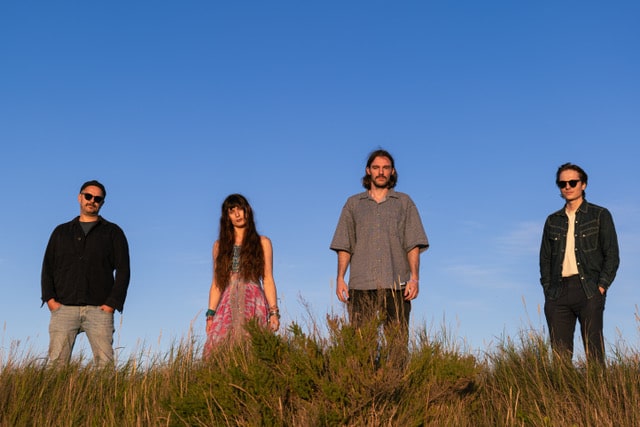
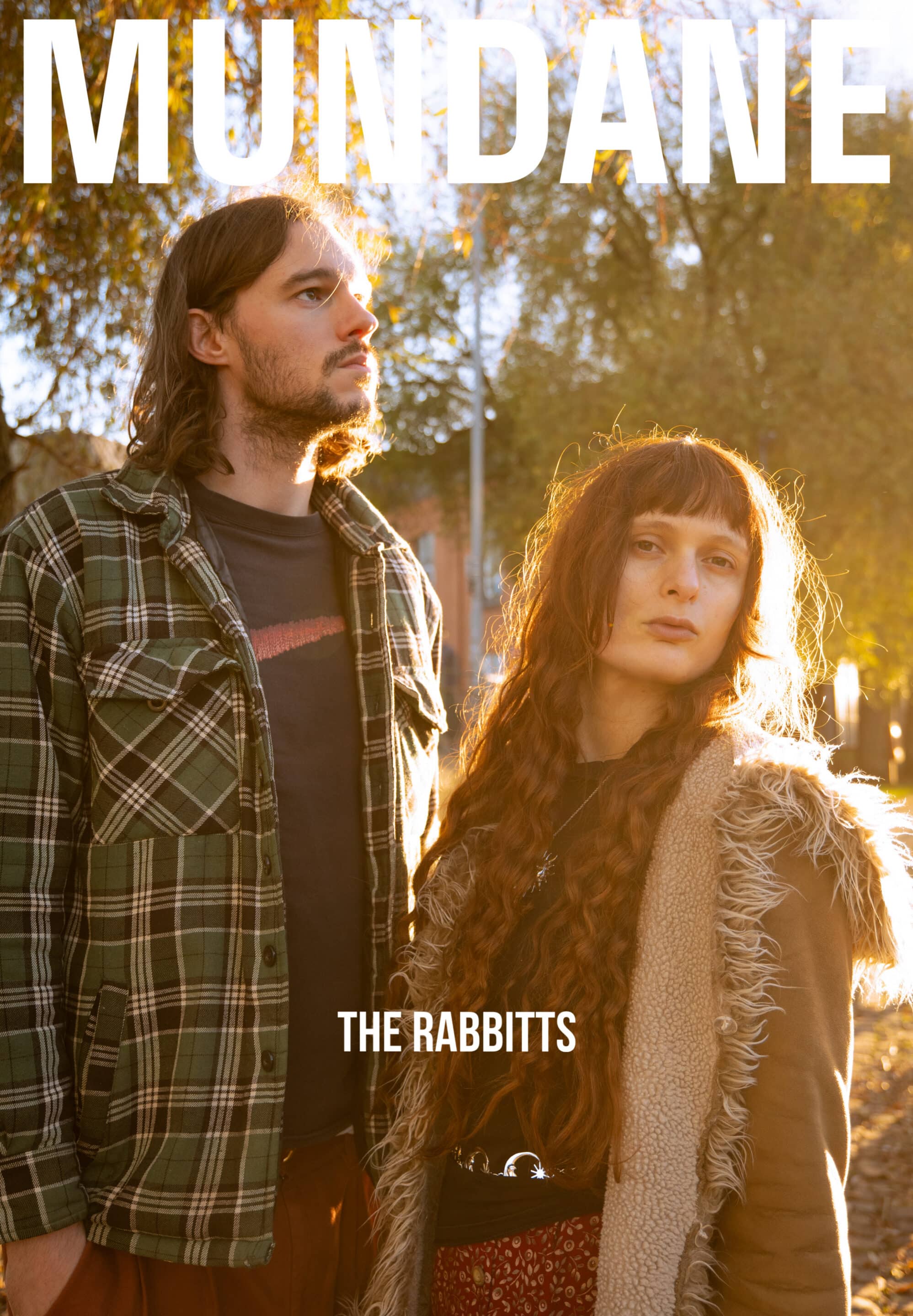
For Norwich-based musical duo The Rabbitts, Paradise began with a spontaneous decision to disappear into the mountains for three weeks. Armed with guitars, forgotten voice notes, and little more than a desire to escape everyday distractions, the pair found themselves in an isolated, snow-covered cabin with no internet and an abundance of creative possibilities. The resulting album is an intimate exploration of love, contrasting perspectives, and the elusive meaning of paradise itself. In an exclusive conversation with MUNDANE, the musicians discuss the beauty of creative isolation, their evolving relationship as songwriting partners, the influences that shape their atmospheric folk sound, and their ambitions to bring their music beyond the United Kingdom.
Paradise means something different to everyone.
For some, it’s a remote cabin surrounded by snow-covered mountains, far removed from the demands of everyday life. For others, it’s somewhere warm, perhaps a quiet coastal town in the south of France, where the sun seems to linger just a little longer.
For Norwich-based musicians Lucy and Oren of , that difference in perspective became the foundation of their latest album, Paradise.
The project emerged from an unusually spontaneous creative retreat that took the pair away from their familiar surroundings and into the mountains for three weeks.
There was no elaborate production schedule, no carefully organized writing camp, and very little preparation.
Instead, they searched Airbnb for an affordable place to stay somewhere in Europe, eventually discovering an isolated mountain cabin available for roughly £400 for three weeks.
The decision was almost immediate.
Getting there, however, proved considerably more complicated.
The narrow mountain roads were covered in snow, and the pair had arrived without snow chains.
They got stuck more than once.
But what initially seemed like a somewhat reckless adventure became one of the most productive creative experiences of their musical partnership.
“We wanted to get away from just everything,” they explain during our conversation.
Without internet access, social obligations, or the endless distractions of everyday life, Lucy and Oren were finally able to dedicate themselves entirely to songwriting.
And somewhere between the isolation, the discomfort, and the extraordinary landscape surrounding them, Paradise began to take shape.
Three Weeks Without Distractions
For many musicians, the creative process is rarely as straightforward as sitting down and writing a song.
Ideas appear unexpectedly.
A melody emerges during a soundcheck. A chord progression arrives while traveling. A fragment of lyrics finds its way into a phone recording, only to disappear among dozens of unfinished sketches.
Lucy and Oren knew this experience well.
Over the years, they had accumulated countless voice notes containing musical ideas they had never fully developed.
Some were only a few seconds long.
Others contained the beginnings of songs that had been waiting for the right moment to emerge.
Before heading into the mountains, they began revisiting those recordings.
During the long drive to the cabin, they listened through old ideas together, rediscovering fragments of music they had almost forgotten existed.
For Lucy, the experience was unexpectedly emotional.
Hearing the recordings brought back memories of the circumstances in which they had been created, including conversations and background noises captured almost accidentally.
Sometimes, a forgotten melody would suddenly reveal itself as something worth pursuing.
Other times, a voice note would transport them back to a particular moment in their lives.
The process became an exercise in musical archaeology, uncovering ideas that had been waiting beneath the surface of their everyday routines.
But the cabin also offered something equally important: time.
“I think that was why as well we were looking to get away,” they explain. “Even with a day off at home where there’s no plans, it’s like things come up.”
Without those interruptions, the pair could finally commit to developing ideas beyond their initial inspiration.
Some songs grew from existing sketches.
Others were written entirely from scratch.
The retreat wasn’t simply about generating material.
It was about creating the conditions in which creativity could become the primary focus of their lives.
The Difference Between an Idea and a Song
One of the most interesting moments in our conversation came when we discussed a familiar problem among musicians: the seemingly endless accumulation of unfinished ideas.
Why do artists record so many melodies, lyrics, and chord progressions without ever turning them into complete songs?
For Lucy and Oren, the answer involves both distraction and the emotional effort required to develop something meaningful.
A thirty-second idea can sound compelling almost immediately.
But transforming that fragment into a finished composition demands patience, concentration, and a willingness to invest something personal in the process.
The challenge isn’t always finding inspiration.
Sometimes it’s finding the energy to do that inspiration justice.
Their mountain retreat provided a solution by removing the usual obstacles between an initial idea and its development.
With few alternatives competing for their attention, songwriting became their daily routine.
The environment also encouraged them to work differently.
Rather than constantly interrupting their creative momentum, they could remain immersed in the same musical ideas for hours.
And perhaps most importantly, they could explore those ideas together.
Two Different Versions of Paradise
Although the album was written in a remote mountain setting, the title Paradise didn’t emerge from a shared sense of having discovered an idyllic place.
Quite the opposite.
For Oren, the isolated cabin represented something close to his ideal environment.
He loved the mountains, the remoteness, and the possibility of living somewhere surrounded by nature.
Lucy, meanwhile, found the experience considerably more challenging.
The cold was intense, the surroundings were unfamiliar, and the isolation wasn’t always comfortable.
As they began discussing the places where each of them felt happiest, an interesting realization emerged.
Their individual ideas of paradise weren’t necessarily the same.
While Oren imagined remaining in the mountains, Lucy was drawn toward the warmth of the south of France.
That contrast became one of the album’s defining themes.
Rather than presenting paradise as a fixed destination, the record explores how happiness, comfort, and belonging can mean different things to different people.
And for two musicians whose personal and creative lives are so closely connected, that distinction carried a deeper significance.
How do two people build something together when they experience the world differently?
How do contrasting instincts become complementary rather than contradictory?
For Lucy and Oren, the answer has always existed somewhere within their songwriting partnership.
“Paradise One” and “Paradise Two”: Two Sides of the Same Story
When asked which song on the album feels most personally significant, the pair hesitate to choose a single favorite.
But “Paradise One” quickly emerges as a particularly meaningful composition.
The song was written about their wedding day and the emotional crash that followed such an extraordinary moment.
It’s an experience that captures one of the album’s central ideas: the relationship between emotional highs and lows.
Even the happiest moments can be followed by feelings that are difficult to anticipate.
And sometimes, those contrasting emotions are inseparable.
“Paradise One” explores that experience through a fuller band arrangement, while its companion piece, “Paradise Two,” offers a more stripped-back interpretation.
Together, the songs represent two different emotional and musical perspectives.
Lucy describes them as feeling like the sun and the moon.
That image is particularly revealing.
Rather than treating light and darkness as opposing forces, the album allows them to coexist.
The two songs become complementary expressions of the same emotional landscape.
Interestingly, “Paradise One” was also among the earliest voice-note ideas the pair revisited during their retreat.
The original recording contained a melody and chord progression, but the lyrics had yet to be written.
It was in the cabin that the song began to find its final form.
What started as a forgotten fragment became one of the emotional foundations of the album.
A Creative Partnership Built on Difference
Lucy and Oren have been making music together since they were young.
Their artistic relationship has developed so naturally that imagining a completely different songwriting process isn’t always easy.
Yet despite their shared history, they acknowledge that their creative instincts are far from identical.
They approach songwriting from different perspectives.
They hear different possibilities within the same ideas.
And their individual influences often lead them toward different musical directions.
But rather than creating conflict, those differences have become essential to the identity of their music.
As they explain, a song rarely feels complete until both of them have contributed to it.
That sense of mutual dependence is especially interesting in a musical landscape where collaboration is often treated as a temporary arrangement between individual artists.
For Lucy and Oren, collaboration isn’t simply a method of producing music.
It’s the foundation of their artistic identity.
Their different approaches allow each song to develop beyond what either might have created independently.
And because the partnership has evolved over so many years, that process now feels almost instinctive.
There is no elaborate system for deciding whose ideas should dominate.
Instead, the music emerges through an ongoing exchange of perspectives.
It’s a dynamic that mirrors the central theme of Paradise itself.
Two people can imagine different destinations and still create something meaningful together.
From Nick Drake to Neoclassical Music
The duo’s musical influences reveal another fascinating contrast.
One side of their creative vocabulary is deeply rooted in folk songwriting and the storytelling traditions of the 1960s and 1970s.
Artists such as Nick Drake, John Martyn, Simon & Garfunkel, and Ben Howard have helped shape their appreciation for intimate arrangements, expressive guitar playing, and emotionally resonant lyrics.
Contemporary artists including Joshua Burnside and David Keenan also feature among the musicians they admire.
But the other side of their musical identity draws from a different world.
Lucy speaks about her growing fascination with classical and neoclassical music, particularly its ability to create immersive emotional environments.
For her, the most compelling compositions are those that transport listeners somewhere entirely different.
She describes wanting people to feel as though they can enter a small universe within the music.
It’s an ambition that extends beyond sound alone.
Cinema is another important source of inspiration.
The experience of watching a beautiful film, becoming absorbed in its atmosphere, and leaving the theater with a changed perspective reflects the kind of emotional journey she hopes music can create.
These influences help explain the distinctive atmosphere of Paradise.
Its folk foundations provide intimacy and narrative clarity, while its more expansive musical sensibilities suggest a fascination with texture, space, and emotional immersion.
The result is music that can feel quiet without being simple.
Restrained without being empty.
And deeply personal without sacrificing the possibility of transporting listeners into an entirely different world.
The Importance of a Sensitive Rhythm Section
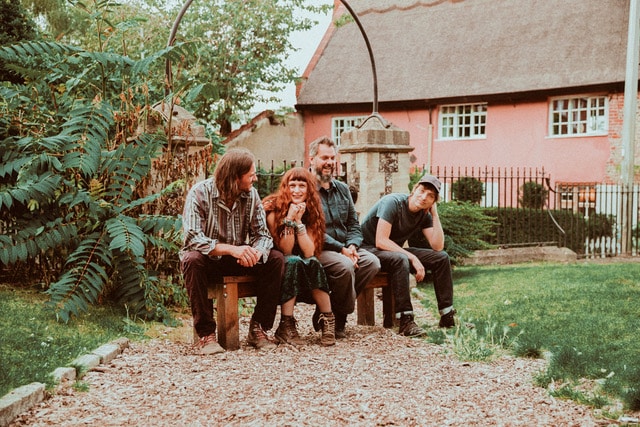
Although Lucy and Oren form the creative center of the project, their music takes on another dimension when performed with a full band.
For their upcoming tour, they will be joined by drummer Julien and bassist Robin, two musicians whose contributions extend far beyond conventional accompaniment.
The duo speaks enthusiastically about Julien’s fascination with unusual percussion textures and his ability to discover unexpected sounds within his drum kit.
Robin, meanwhile, is described as an exceptionally expressive bassist whose playing responds closely to the emotional character of the vocals.
That sensitivity is particularly important for music built around subtle arrangements.
In louder genres, a rhythm section can create impact through volume and intensity.
But within quieter folk-oriented compositions, every instrumental decision becomes more exposed.
A bass line can change the emotional direction of a verse.
A restrained percussion texture can create tension without overwhelming the melody.
And the smallest rhythmic gesture can dramatically alter the atmosphere of a song.
Lucy and Oren explain that their bandmates approach the music with an unusually collaborative mindset.
Although they might technically be considered session musicians, their involvement feels much more substantial.
Both contribute creative ideas and take an active role in shaping the live arrangements.
The goal isn’t simply to reproduce the recordings with additional instruments.
It’s to create a unified musical experience in which every element responds to the others.
That philosophy also influences the recording process.
The musicians frequently record several instruments together, allowing the interaction between players to become part of the finished sound.
For Lucy and Oren, preserving that human connection is essential.
They want the recorded versions of their songs to retain the immediacy and emotional sensitivity of a live performance.
Bringing Paradise to the Stage
Following the album’s release, the duo is preparing for a 15-date tour across England and Scotland.
The performances will feature the full band, with the new album forming the centerpiece of the setlist alongside selected songs from earlier releases.
For Lucy and Oren, the tour represents an opportunity to translate the intimate world of Paradise into a shared experience with audiences.
The songs may have originated in isolation, but their next chapter will unfold in rooms filled with people.
That transition is particularly meaningful given the circumstances of the album’s creation.
What began as a private retreat, disconnected from the outside world, is now becoming something that can be experienced collectively.
The pair are also thinking beyond the immediate release cycle.
Although touring remains their primary focus, they have already begun discussing future writing sessions and ways to continue developing the musical ideas introduced on Paradise.
The retreat proved so valuable that they hope to repeat the experience.
They are also interested in exploring the new instruments and arrangements that became part of this record.
And perhaps most excitingly, they hope to expand their live presence beyond the United Kingdom.
Having previously performed several shows in Germany, the duo is eager to reach audiences farther afield, including the United States.
For a project whose music is built around intimacy, storytelling, and atmospheric arrangements, the prospect of connecting with listeners across different countries offers an exciting next step.
In Conversation With Lucy and Oren
The following conversation has been edited for clarity and readability.
MUNDANE: Paradise began with a three-week writing retreat in an isolated cabin. How did the idea come about, and what was that experience like?
Lucy and Oren: We wanted to get away from everything, really. We were looking on Airbnb for somewhere affordable in Europe where we could spend three weeks writing. We found this place up in the mountains that was something like £400 for the whole stay, so we decided to go.
We didn’t really prepare for it. We were driving up this tiny mountain road, and everything was covered in snow. We didn’t have snow chains, so we got stuck a couple of times.
It was an adventure.
But it was really good to get away. There wasn’t internet, there weren’t people around, and there wasn’t much to do apart from being outside and writing music.
MUNDANE: Three weeks isn’t a long time to write an album. How did you manage to develop so much material in such a concentrated period?
Lucy and Oren: Over the years, we’d collected so many voice notes with little musical ideas that we’d never finished.
Some of them were melodies, some were chord progressions, and some were things we’d recorded quickly during a soundcheck or when an idea came into our heads.
We knew there were a few that we wanted to develop for the album, so we took those with us.
But quite a few songs were also written completely from scratch while we were there.
I think the environment made a huge difference. There weren’t any distractions, and we could just focus on writing.
MUNDANE: What was it like revisiting all those old voice notes? Did hearing them bring back memories of the moments when you first recorded them?
Lucy and Oren: It was really special.
We listened to a lot of them during the drive down, and it was exciting hearing ideas we’d completely forgotten about.
Sometimes you’d hear something and think, “Oh my God, I love this idea. Why did I forget about it?”
You could also hear voices and sounds in the background from whatever was happening when we’d recorded them.
It really took us back to those moments.
And we both started finding songs where we thought, “We have to do this one.”
That was a really exciting part of the process.
MUNDANE: Why do you think musicians accumulate so many unfinished ideas? What prevents a promising melody or chord progression from becoming a complete song?
Lucy and Oren: I think a lot of it is distraction.
Even when you have a day off at home, things come up. Suddenly you have to do something else, and it becomes difficult to block out the time to be creative.
That’s part of why we wanted to go away.
We wanted to put ourselves somewhere different and say, “This is the time we’re going to spend writing, and we’re not going to let anything else interfere.”
I also think it’s quite easy to come up with a melody, some lyrics, or a few chords that sound good for thirty seconds.
But turning that into a complete song takes a lot more energy.
If you really like an idea, you want to do it justice, and that means putting a lot of yourself into it.
Sometimes you just don’t have the energy or the space to do that.
MUNDANE: Which song on Paradise feels most personally significant to you? Is there one that captures the emotional essence of the album?
Lucy and Oren: That’s a difficult question because it’s hard to choose a favorite.
But I think “Paradise One” feels particularly special.
We wrote it about our wedding day and the crash that followed such a lovely time.
Throughout the album, we wanted to explore contrasts, especially light and dark.
When you pair “Paradise One” with “Paradise Two,” I feel like they represent the album quite well.
“Paradise One” has the fullness of the band, while “Paradise Two” is much more stripped back.
They feel a little like the sun and the moon to me.
And actually, “Paradise One” was one of the first voice notes we revisited. We had the melody and chord progression, but I think the lyrics were among the first we started writing in the cabin.
MUNDANE: The idea of paradise is so subjective. How did that theme develop while you were writing the record?
Lucy and Oren: I think it came from being in that environment.
We realized we had very different feelings about where we were.
For Oren, it was almost a dream place. He was saying he wanted to move there and live in the mountains.
But I was really cold, and it was quite uncomfortable for me in some ways.
I was saying we could move somewhere warmer, maybe down toward the sea in the south of France.
So we started talking about the different places we love and where we each feel happiest.
We realized that paradise doesn’t necessarily mean the same place for both of us.
That became an interesting idea to explore through the album.
MUNDANE: You’ve been making music together since you were young. How has your creative relationship evolved, particularly when you approach songwriting differently?
Lucy and Oren: I think it has definitely evolved.
We write quite differently, but somehow it comes together naturally.
I don’t think a song ever feels complete until the other person has contributed to it.
We approach things in different ways and think about music differently, but we often arrive at the same result.
Our different perspectives complement each other.
Because we’ve been making music together for so long, it’s difficult to compare our process with anything else.
It just feels natural.
We’re not trying to write in a particular way or force the music to become something specific.
It develops through the way we work together.
MUNDANE: Your music has a strong storytelling quality, with influences from alternative folk and acoustic traditions. Which artists or other creative voices inspire you most?
Lucy and Oren: There are so many artists we admire.
Joshua Burnside, David Keenan, and Ben Howard have all been important influences.
And then there are older artists from the 1960s and 1970s, like John Martyn, Simon & Garfunkel, and Nick Drake.
But we also have quite different influences.
I’ve been listening to a lot of classical and neoclassical music recently.
I love music that makes you feel like you’re entering a completely different world.
That’s something I really enjoy trying to create in our songs: little worlds that people can crawl inside.
I get a similar feeling from cinema.
Sometimes you watch a beautiful film and come out feeling like your mind has been opened up in a completely different way.
I love art that can do that.
 MUNDANE: You’re bringing the album on tour with a full band. How do you preserve the intimacy of your songwriting while incorporating a rhythm section?
Lucy and Oren: We’re really lucky with the musicians we work with.
Our drummer Julien is incredibly interested in different textures and sounds. He’s always exploring what he can get out of his drum kit.
And Robin, our bassist, is so expressive.
They’re both really sensitive to the music.
Even though they might technically be session musicians, it feels like much more than that.
They’re invested in the project, and they contribute creatively.
Robin will listen to the way we’re singing something and respond to the vocal with his bass playing.
It’s about making everything fit together.
We don’t want the essence of the song to become masked by the additional instruments.
We also record quite a lot of our music live, with the instruments playing together in the room.
It’s nice when the recorded sound and the live sound aren’t too different.
MUNDANE: What can audiences expect from the upcoming tour?
Lucy and Oren: We’re doing fifteen dates around England and Scotland.
It’ll be full-band shows with Julien on drums and Robin on bass.
We’ll be playing the album, along with a few older songs and favorites.
We’re really excited to bring the music to people and hear how the songs develop in that setting.
MUNDANE: With Paradise entering the world, are you already thinking about your next creative chapter, or is your attention entirely on the album and the tour?
Lucy and Oren: At the moment, we’re very focused on the tour.
But we’ve also started talking about what comes next.
We don’t want to finish the album cycle and suddenly find ourselves wondering what to do.
We’ve begun making plans for next year, and we’d love to continue exploring the sounds we developed on Paradise.
We introduced some new instruments on this record, and we’d like to develop those ideas further.
We also really enjoyed the writing retreat.
Having that dedicated time was invaluable, so we’d love to do something similar again.
And hopefully we’ll be able to play more shows outside the UK.
We’ve mostly been touring here recently, although we did some dates in Germany a couple of years ago.
We’d love to travel farther afield and hopefully bring our music to America.
Paradise Is Something You Create Together
What makes Paradise particularly compelling is the way its creation mirrors the ideas it explores.
Two musicians leave their everyday lives behind in search of a place where they can focus entirely on making music.
They arrive in the mountains expecting isolation to provide clarity.
Instead, they discover that even their understanding of an ideal place is fundamentally different.
One finds comfort in the cold and solitude.
The other imagines warmth and the sea.
Yet rather than allowing those differences to divide their creative vision, they transform them into the emotional foundation of an album.
That same philosophy defines their musical partnership.
Lucy and Oren don’t necessarily approach songwriting in the same way, nor do they share identical influences.
But their contrasting instincts have become inseparable from the sound they create together.
The intimacy of their folk songwriting, the atmospheric possibilities of classical music, and the sensitivity of their full-band arrangements all contribute to a musical identity that feels both personal and expansive.
And perhaps the most revealing detail of the entire process is that so much of Paradise began with ideas they had nearly forgotten.
Small melodies recorded in passing.
Unfinished chord progressions.
Moments preserved on a phone and left waiting for the right circumstances.
It took three weeks in an isolated cabin to give those fragments the attention they deserved.
Now, as Lucy and Oren prepare to bring the album on tour and explore the possibility of performing beyond the United Kingdom, the music is beginning a journey far removed from the mountains where it took shape.
Ultimately, Paradise suggests that the perfect place may not be somewhere we discover at all. It may be something we create through connection, patience, and the willingness to embrace another person’s perspective.
And for two artists who have spent much of their lives making music together, that idea feels like a particularly meaningful place to begin.