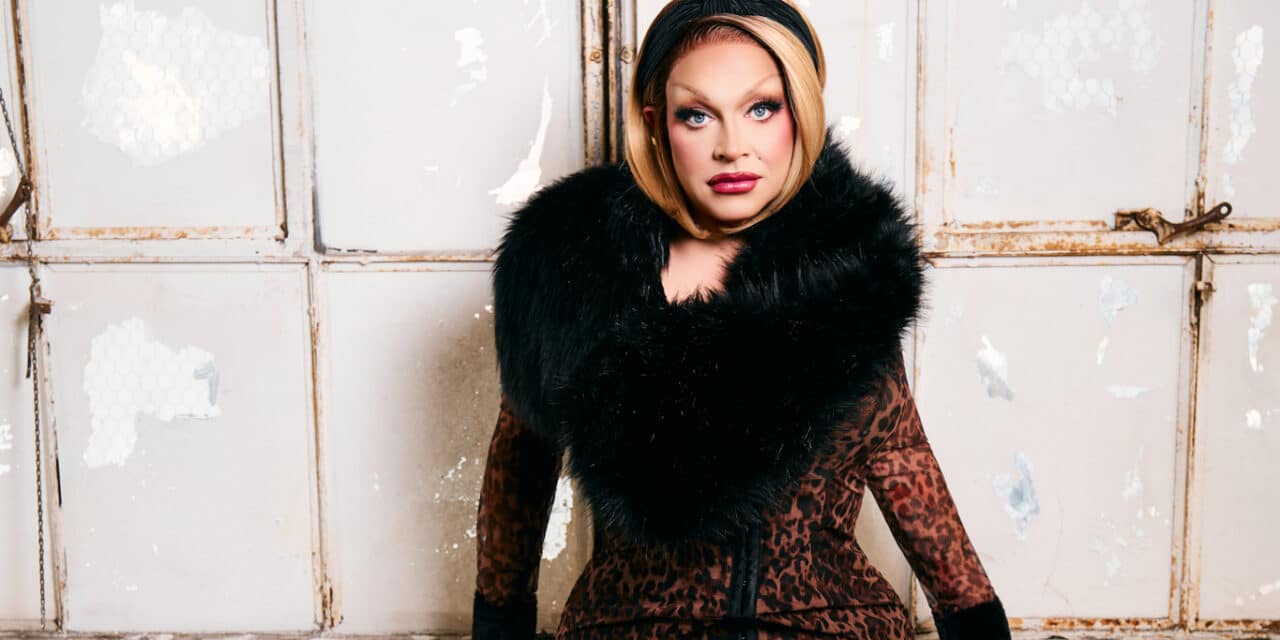
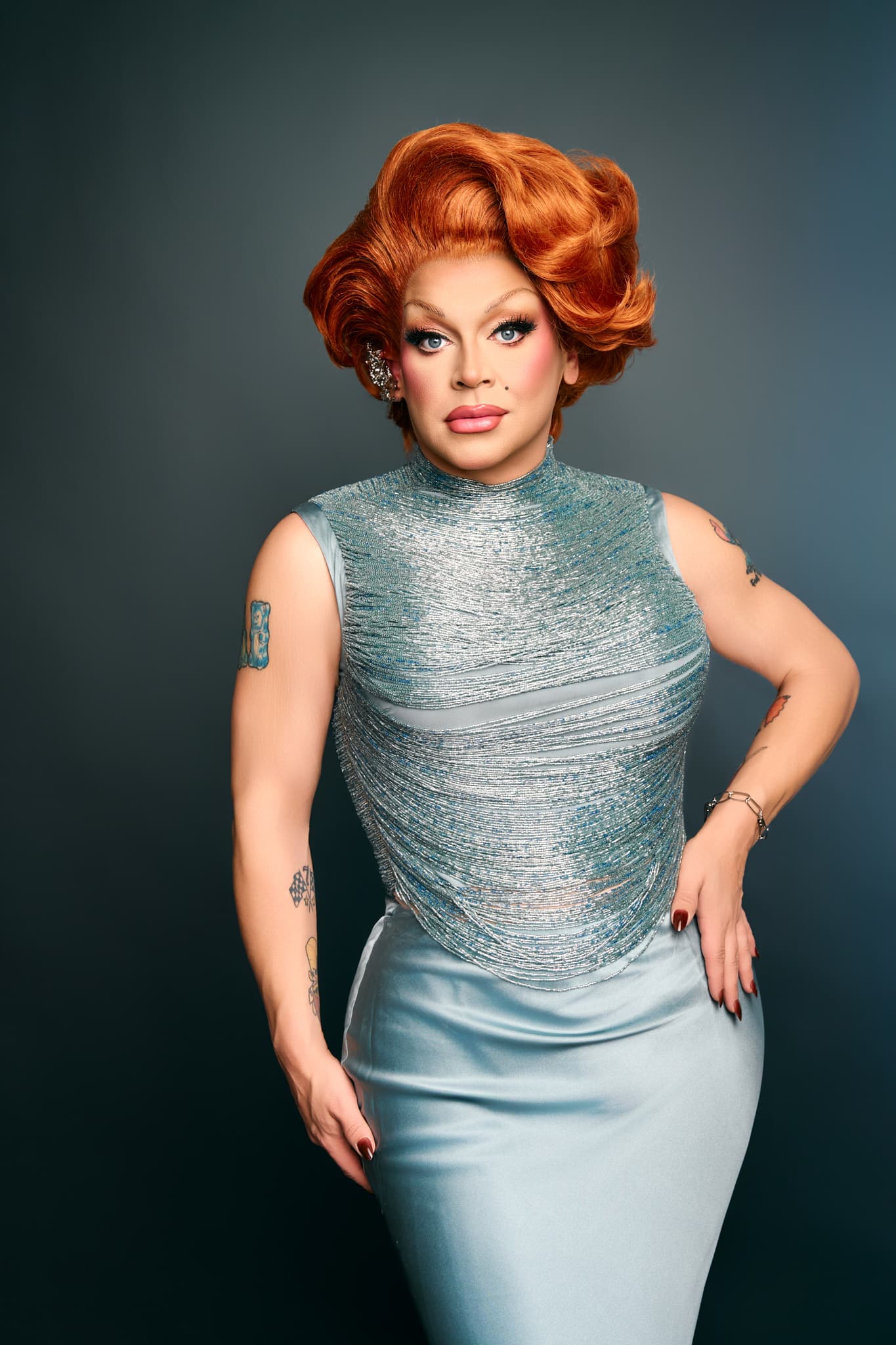
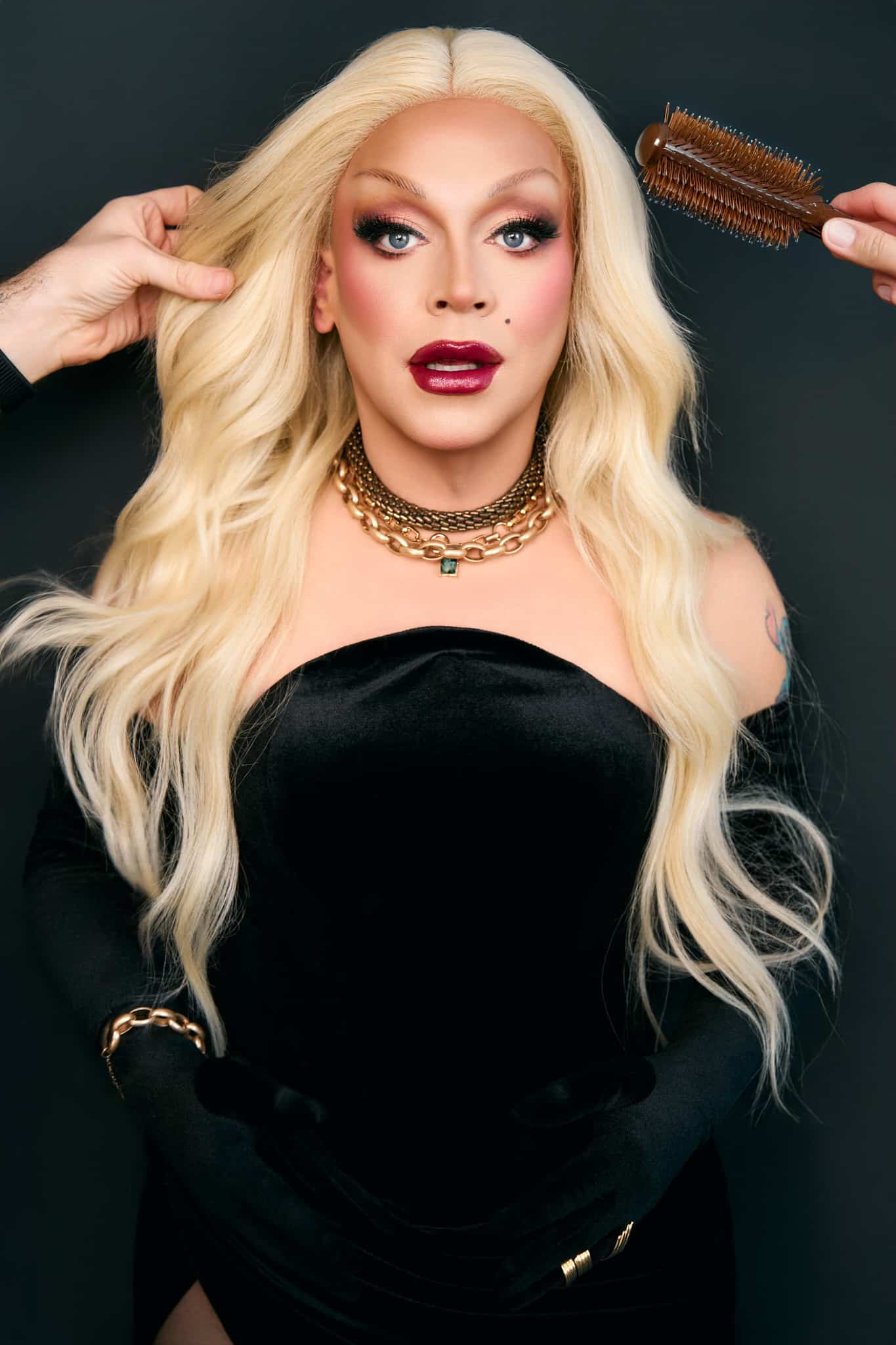
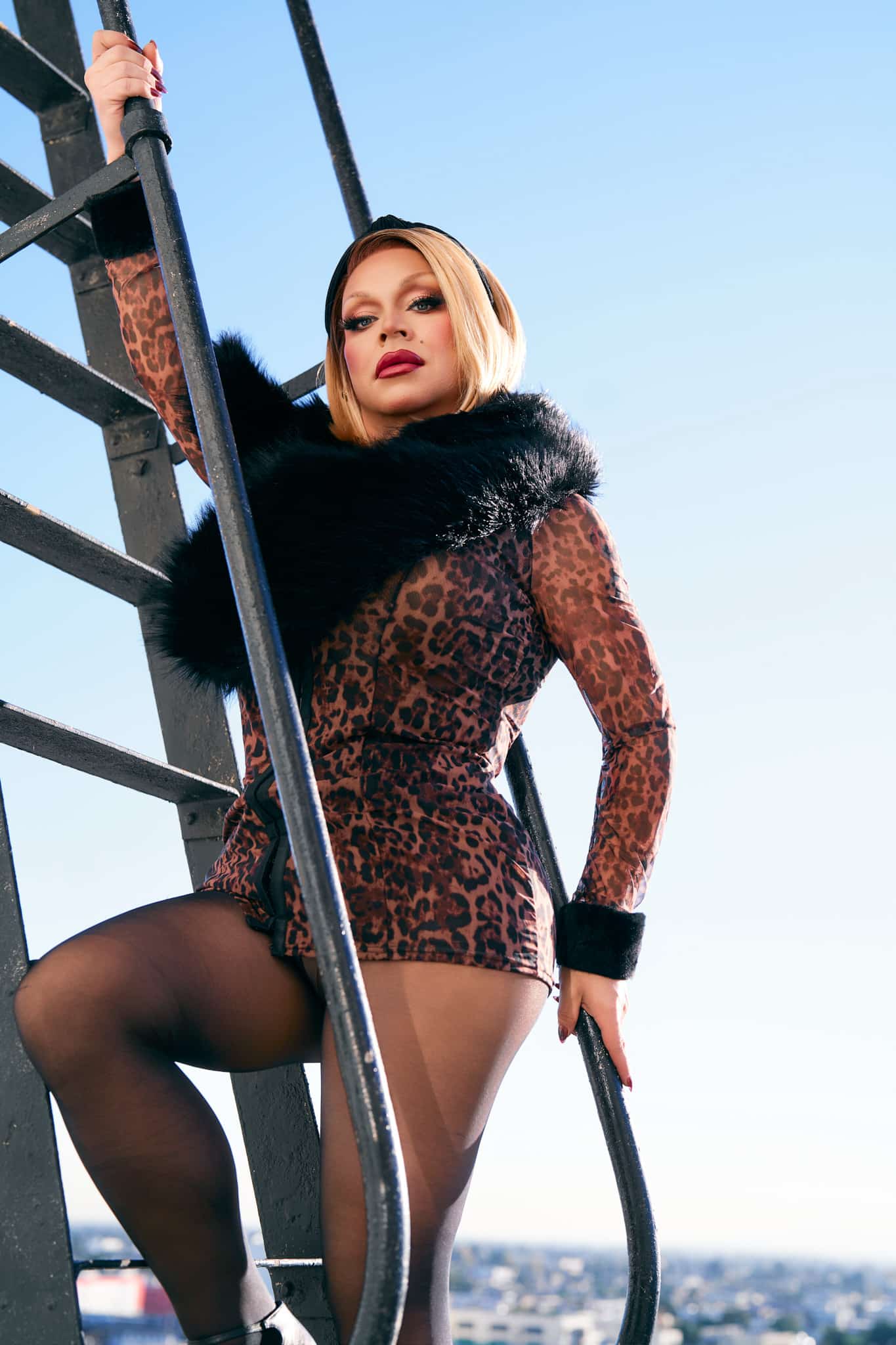
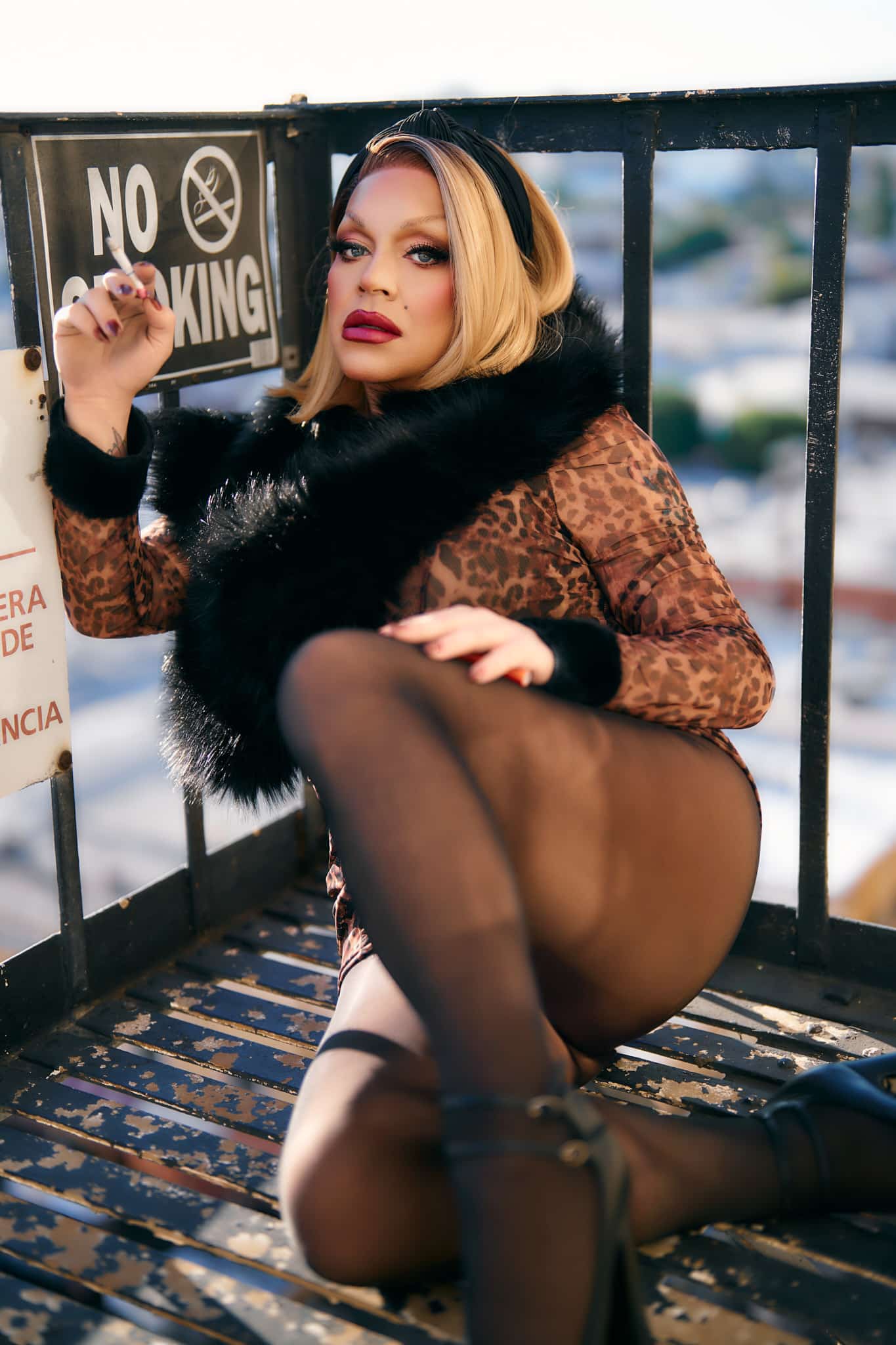
Fresh off her RuPaul’s Drag Race All Stars Season 10 victory, Ginger Minj returns to her theatrical roots with The Broad’s Way, a new EP reimagining Broadway classics through her signature blend of humor, vulnerability, and unapologetic showmanship. Ahead of her November 10 debut at New York’s 54 Below, the drag icon opens up about Sondheim, the art of storytelling, and why embracing her inner theater kid changed everything.
There’s a particular kind of performer who doesn’t simply enter a room. They make an entrance.
Ginger Minj has spent much of her career perfecting that distinction.
Whether she’s commanding a drag stage, delivering a punchline, appearing on screen, or belting a Broadway standard, the Florida-born entertainer understands something fundamental about performance: spectacle might get an audience’s attention, but emotional truth is what makes them stay.
And after years of navigating the worlds of drag, television, film, music, and theater, Ginger is returning to one of her earliest artistic loves.
Her new EP, The Broad’s Way, arrives November 6 via PEG Records, distributed by ADA/Warner Music Group, offering a collection of Broadway classics reimagined through the unmistakable personality of Ginger Minj.
Featuring songs from Sister Act, Man of La Mancha, Wicked, Company, Annie Get Your Gun, and La Cage aux Folles, the project is more than a celebration of musical theater.
It’s a statement about identity, artistic freedom, and the importance of refusing to separate the different parts of yourself simply because the entertainment industry prefers neatly defined categories.
For Ginger, Broadway isn’t a departure from drag.
It’s part of the reason she became a drag performer in the first place.
“I had to narrow it down to songs that represented who I was, who I am, and who I hope to become,” she explains.
It’s a revealing way to describe a collection of covers.
Rather than choosing songs simply because they’re iconic, Ginger approached the project as an opportunity to tell her own story through material that generations of theatergoers already know by heart.
And naturally, she had a difficult time narrowing things down.
A Broadway Baby Who Refuses to Grow Up
The title The Broad’s Way is classic Ginger Minj: irreverent, theatrical, and entirely self-aware.
But behind the wordplay is a genuine devotion to musical theater.
The EP’s six tracks span a remarkable range of theatrical traditions, from the aspirational grandeur of “The Impossible Dream” to the defiant individuality of “I Am What I Am.”
There’s the exuberance of “Fabulous, Baby!” from Sister Act, the soaring ambition of “Defying Gravity” from Wicked, and the competitive humor of “Anything You Can Do (I Can Do Better),” featuring fellow Drag Race favorite Jujubee.
Then there’s Stephen Sondheim’s “The Ladies Who Lunch,” perhaps the project’s most intriguing selection.
Taken together, the songs suggest an artist interested in the full emotional vocabulary of theater.
Confidence and insecurity.
Ambition and disappointment.
Defiance and vulnerability.
And, of course, the pleasure of being just a little bit ridiculous.
For Ginger, choosing the material meant confronting the impossible task of selecting favorites from a lifetime of theatrical obsession.
“I’m such a Broadway baby that it was difficult to narrow the EP down,” she admits.
The problem only became more complicated when she began preparing for her upcoming 54 Below performance.
Initially, the prospect of an expanded setlist seemed liberating.
Finally, she could sing everything.
But after assembling approximately thirty songs, she found herself facing the same dilemma all over again.
The solution was to focus less on personal favorites and more on what each song revealed about her.
In that sense, The Broad’s Way functions almost like an unconventional autobiography.
One written in the language of Broadway.
Three Martinis Deep With Stephen Sondheim
If there’s one song that captures the intersection of Ginger’s humor and theatrical instincts, it’s “The Ladies Who Lunch.”
Originally introduced by Elaine Stritch in Stephen Sondheim’s Company, the song has become one of musical theater’s great character studies: a portrait of sophistication, disillusionment, social performance, and the quiet desperation lurking beneath the surface.
It’s also a song with a particularly devoted following among gay theater enthusiasts.
Ginger knows this better than most.
“There are certain things every gay man is issued at birth: a sense of irony, an opinion about Judy Garland, and a questionable amount of confidence performing ‘The Ladies Who Lunch’ three martinis deep,” she jokes.
“I’m just doing my part to keep the tradition alive.”
But the song’s appeal goes much deeper than camp recognition.
For Ginger, its protagonist, Joanne, becomes increasingly relatable with age.
Joanne is both an insider and an outsider, someone who understands the social world around her while remaining profoundly alienated from it.
She observes, judges, participates, and questions.
And beneath the humor is a deeply recognizable human discomfort.
“We’ve all felt like we don’t fit in,” Ginger explains. “We’ve all felt like outsiders observing a group of people we both completely understand and yet completely dumbfound us.”
It’s precisely that contradiction that makes the song such an effective choice for her.
Drag has always been particularly adept at exposing the absurdity of social performance.
Through exaggeration, humor, and theatricality, it reveals the insecurities that people often work hardest to conceal.
And Sondheim’s writing operates in a surprisingly similar way.
The wit is sharp, but the emotional undercurrent cuts deeper.
For Ginger, that combination is irresistible.
The Art of Being Too Much
There was a time when Ginger Minj tried to make herself smaller.
Not physically, and certainly not in terms of personality, but artistically.
As her career expanded through RuPaul’s Drag Race, she became increasingly aware of the expectations surrounding reality television performers.
And for years, she attempted to suppress the theater kid who had always been at the center of her identity.
It didn’t work.
“Theatre Kids get a bad rap,” she says. “We’re loud, we’re passionate, we’re dramatic.”
Those qualities are often treated as liabilities in environments that prize effortless cool or carefully curated restraint.
But for Ginger, attempting to distance herself from those instincts eventually became creatively suffocating.
“I tried (unsuccessfully, I’m sure) to hide that side of myself from the reality TV crowds for years and I felt stifled as an artist.”
The turning point came when she stopped trying.
Rather than reshaping herself to fit the expectations of a particular audience, she embraced the theatrical sensibility that had always informed her work.
And according to Ginger, that decision changed the trajectory of her career.
“It wasn’t until I said screw it and just embraced the things I really loved that I truly started finding success.”
It’s an important observation from an entertainer whose public identity has always appeared larger than life.
Even the most visibly confident performers can feel pressure to conceal the qualities that make them distinctive.
For Ginger, the answer wasn’t to become more polished or more universally palatable.
It was to become more herself.
Her message to fellow theater kids is appropriately simple.
“Stay weird, my friends, the world needs it!”
Beyond the Werk Room
Of course, Ginger Minj’s career has long extended beyond the confines of Drag Race.
Her appearances on Season 7, All Stars Season 2, and All Stars Season 6 established her as one of the franchise’s most recognizable theatrical personalities.
Her eventual victory on All Stars Season 10 added another milestone to a career that had already evolved in several directions.
Over the past decade, she’s toured internationally, released four studio albums, developed acclaimed stage productions, and built an increasingly diverse screen career.
Her film credits include Netflix’s Dumplin’, alongside Jennifer Aniston and Dove Cameron, and Disney+’s Hocus Pocus 2.
In 2023, she published Southern Fried Sass, a memoir-meets-cookbook that combined Southern-inspired recipes with personal stories and reflections.
The project was another expression of her instinct to blend entertainment with autobiography.
More recently, Ginger returned to the musical theater stage as Edna Turnblad in Hairspray at Broadway Sacramento, while also bringing the sapphic Wicked parody Licked: For Gay to Provincetown alongside Jujubee.
Her touring production Hokus Pokus Live! reached more than 22,000 attendees across North America, and she was recognized as part of the 2025 OUT100.
Yet despite the variety of projects, Ginger doesn’t view her career as a collection of disconnected identities.
“I’m just me,” she says.
“I’m a singer/writer/storyteller who likes to share myself with the world. I’m fun, I’m funny, I’m flawed … I’m human.”
That understanding of herself as a storyteller, rather than simply a drag performer or actor, helps explain the coherence of her work.
The medium changes.
The fundamental artistic impulse doesn’t.
Why Nothing Replaces a Live Audience
On November 10, Ginger will make her debut at New York City’s 54 Below, the celebrated cabaret venue known for its intimate performances and deep connection to Broadway culture.
The evening will feature selections from The Broad’s Way, additional material, and surprise guests.
For an entertainer accustomed to everything from television studios to large-scale theatrical productions, the cabaret setting offers a particular kind of creative opportunity.
Ginger believes there’s something uniquely vulnerable about performing live.
Film acting demands subtlety because the camera captures the smallest expression.
Recording music requires a different kind of intimacy, with a microphone close enough to reveal every detail.
But standing in front of an audience creates a relationship that neither medium can fully reproduce.
“I’ve never felt more vulnerable and connected than I do in a room full of people,” she explains.
The emotional exchange is immediate.
The audience reacts, the performer responds, and the experience changes from moment to moment.
For Ginger, that unpredictability is part of the pleasure.
“Any entertainer worth their salt knows how to read the room.”
Her philosophy is simple: a performance should respond to the people experiencing it.
“Don’t give them the show YOU want, give them the show THEY are asking for.”
It’s a perspective that reveals the discipline beneath her seemingly spontaneous theatrical persona.
Great performers don’t simply demand attention.
They understand how to listen.
And sometimes the most effective way to command a room is to let the room tell you what it needs.
Finding the Truth Beneath the Camp
Ginger cites Judy Garland and Lucille Ball among the artists who shaped her understanding of storytelling.
It’s an illuminating combination.
Garland’s performances often carried an almost unbearable emotional directness, while Ball transformed physical comedy, exaggeration, and carefully constructed chaos into an art form.
Both understood that theatricality becomes more powerful when grounded in something recognizable.
Ginger has absorbed that lesson.
“I love taking things that people think they know and turning them on their head,” she says.
That instinct lies at the heart of The Broad’s Way.
These are songs with established histories, beloved performances, and deeply ingrained cultural associations.
Some have become anthems of self-acceptance.
Others are monuments to ambition, disappointment, or emotional survival.
But Ginger isn’t approaching them as museum pieces.
She’s interested in what happens when a familiar song is filtered through a different life, a different voice, and a different set of experiences.
It’s also what makes drag such a natural home for musical theater.
Both forms invite performers to inhabit characters larger than themselves while revealing truths that can be difficult to express without a costume, a spotlight, or a particularly dramatic key change.
And with The Broad’s Way, Ginger is embracing that connection without reservation.
She’s no longer interested in hiding her theatrical instincts.
She’s building an entire project around them.
As for what audiences can expect from the 54 Below performance that they won’t find on the recording?
Ginger promises more songs, more chaos, and a healthy dose of herself.
Which, considering the artist in question, sounds like exactly the point.
In Conversation With Ginger Minj
The Broad’s Way features a collection of iconic Broadway songs. How did you choose this specific tracklist, and what was the process like for putting your own “Ginger Minj” stamp on such classic numbers?
It’s been a journey, for sure! I’m such a Broadway baby that it was difficult to narrow the EP down to just five songs. When it came time to expand on that for the 54 Below show I thought, “Oh! Finally I’ll be able to sing ALL of my favorites!” But as I was making the setlist and found myself about thirty songs deep, I realized I was right back where I was in the beginning: a proud mama struggling to pick her favorites. I had to narrow it down to songs that represented who I was, who I am, and who I hope to become, which means a lot of other favorites fell to the wayside. That’s okay, though, we’ll save them for the sequel!
You’ve described “The Ladies Who Lunch” as a song every gay man is practically issued at birth. Why was this the right track to lead the project with, and what does it represent for you as an artist?
Yeah, it’s a cheeky little quip, but I think the song genuinely strikes a cord with anyone and everyone. The older I get, the more of an emotional bond I feel with Joanne in “COMPANY”! We’ve all felt like we don’t fit in, we’ve all felt like outsiders observing a group of people we both completely understand and yet completely dumbfound us, we’ve all been a little more judgemental than maybe we should have been. It’s a fun, funny song with a deeply cutting emotional undercurrent.
Between your residency in Provincetown, your memoir, and your screen work, you’re constantly shifting between different artistic mediums. Does the stage offer a specific kind of freedom or vulnerability that you don’t find on screen?
Oh, absolutely! It’s funny because acting for film has to be so small and intimate because the camera is right in your face, when you’re singing in a recording studio, all has to be quietly emotional because the microphone is inches away, but I’ve never felt more vulnerable and connected than I do in a room full of people. Sure, the emotions are heightened, the vocals are bigger and the emotions are heightened, but there’s something about that shared experience that is so immediate and personal.
You’re making your 54 Below debut on November 10. For those who haven’t seen your live show, how do you adapt your stage performance when moving into such an intimate, cabaret-style setting?
Any entertainer worth their salt knows how to read the room. My performances have always changed night to night depending on the energy from the crowd. Don’t give them the show YOU want, give them the show THEY are asking for. It’s more fun and fresh that way!
With a career that spans drag, acting, and music, do you find that your creative process changes depending on the project, or is there a common thread that connects everything you do?
I’m just me! I’m a singer/writer/storyteller who likes to share myself with the world. I’m fun, I’m funny, I’m flawed … I’m human. I learned the art of storytelling from icons like Judy Garland and Lucille Ball: find the truth in every scenario and make it better! I love taking things that people think they know and turning them on their head.
Looking back at your journey from Season 7 of Drag Race to now, how do you feel your relationship with the Broadway and theatrical world has evolved?
Theatre Kids get a bad rap. We’re loud, we’re passionate, we’re dramatic and very, very passionate. I tried (unsuccessfully, I’m sure) to hide that side of myself from the reality tv crowds for years and I felt stifled as an artist. It wasn’t until I said screw it and just embraced the things I really loved that I truly started finding success. To all of my theatre kids out there: stay weird, my friends, the world needs it!
What can audiences expect from the 54 Below show that they won’t get from just listening to the EP?
More music, more mayhem and, in the words of Madeline Ashton, a lot more “Me! Me! Me!”
The Broad’s Way — Tracklist
- Fabulous, Baby!
- The Impossible Dream
- Defying Gravity
- The Ladies Who Lunch
- Anything You Can Do (I Can Do Better) [feat. Jujubee]
- I Am What I Am
The Broad’s Way arrives November 6, 2026, via PEG Records, distributed by ADA/Warner Music Group.
Ginger Minj makes her 54 Below debut in New York City on November 10, performing selections from the EP alongside special guests.
Listen and explore: “The Ladies Who Lunch” | Pre-save The Broad’s Way | 54 Below performance
Follow Ginger Minj on Instagram.