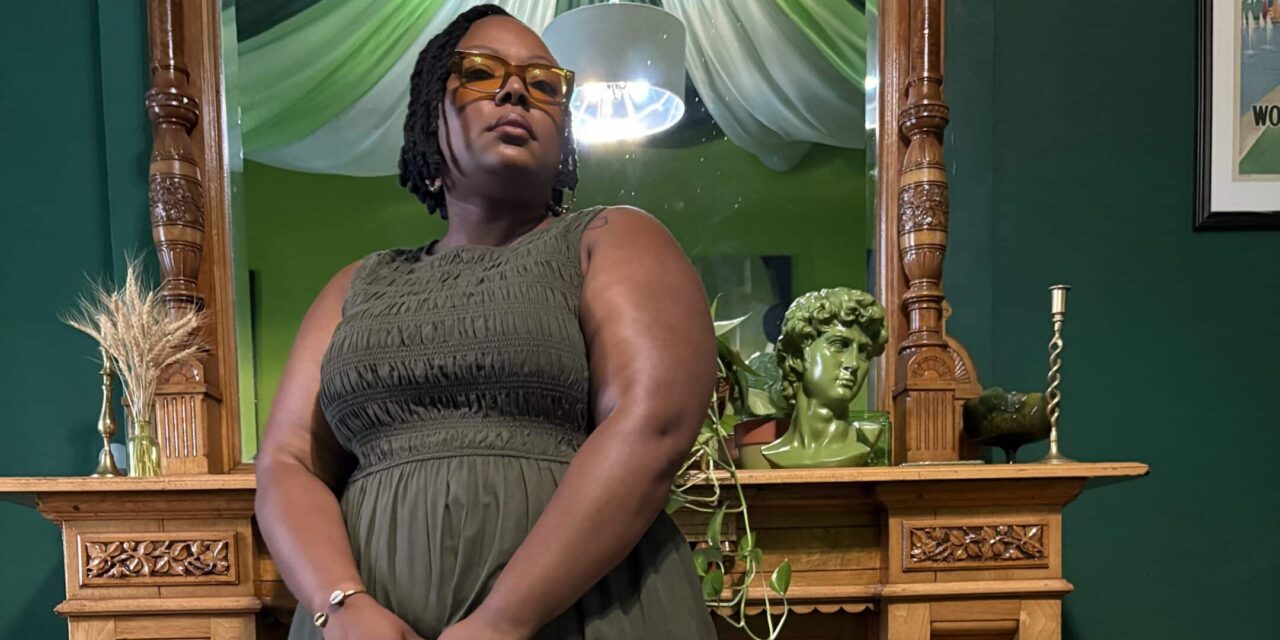
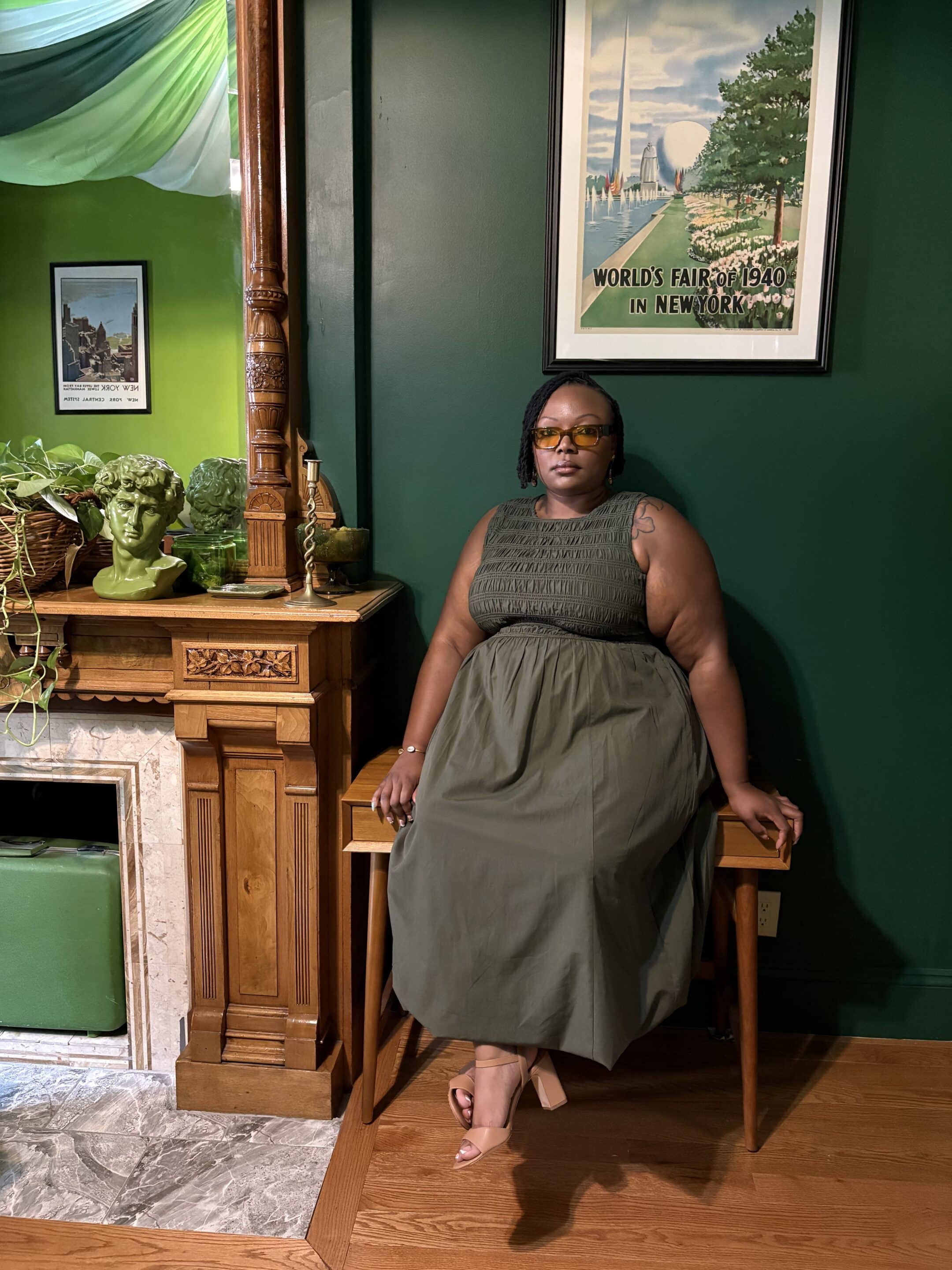
For Cheyenne Atkins, interpreting music is an act of connection. It means understanding what an artist is communicating, what makes a performance feel alive, and how that experience can be carried into a visual language without losing its meaning. That perspective becomes especially important on a concert stage, where preparation, instinct, and an understanding of the artist can determine how a Deaf audience experiences the performance.
As a nationally certified ASL interpreter, accessibility consultant, mentor, and advocate, Cheyenne Atkins approaches access as something that should be considered before an event ever reaches the stage. Her experience interpreting live performances, including Jay-Z’s appearance at The Roots Picnic and Bruno Mars’ Philadelphia concerts, has given her a close view of the preparation, production decisions, technology, communication, and working conditions that can shape an accessible experience. Through Elevated Access Co. and her leadership with NAOBI-DC, she also works to address the barriers Black interpreters continue to face, from limited representation and mentorship to the financial realities of certification and the need for sustainable professional opportunities.
That same understanding shapes what Atkins wants the industry to reconsider. Accessibility cannot begin when someone requests an interpreter or when an event is already taking shape. It has to be part of the conversation from the beginning, with Deaf and disabled people involved in decisions that affect their access and with interpreters given the preparation, resources, and conditions required to do their work well. In this conversation, Atkins reflects on what audiences rarely see behind an interpretation and why meaningful access depends on treating it as part of the experience itself.
You grew up in Roosevelt, New York, and later studied interpreting at Central Piedmont Community College and Gallaudet University. What initially sparked your interest in sign language, and when did you realize it could become your profession?
My first exposure to sign language was in elementary school. During our after-school program, we had the opportunity to choose from different activities, and I was immediately drawn to American Sign Language. At the time, I had no idea it could become a career; it was simply something I genuinely enjoyed and connected with.
It wasn’t until I moved to North Carolina that I realized my childhood interest in ASL could actually become a profession. I’ve always been a visual learner, so sign language felt like a natural fit for me, and I picked it up quickly. Once I entered my first interpreter training program at Central Piedmont Community College and began learning more about Deaf culture, the Deaf community, and the profession of interpreting, I fell even more in love with it.
After graduating from Central Piedmont in 2018, I took a gap year before continuing my education at Gallaudet University in the fall of 2019. What started as an after-school activity when I was a child ultimately grew into a career and a passion that has shaped so much of who I am today.
Interpreting music in sign language requires conveying much more than a song’s lyrics. How do you transform the rhythm, intention, artist’s personality, and audience’s energy into a visual experience?
I have a background in dance and performance, so I’m no stranger to the stage. A lot of the same principles that apply to dance also apply to how I approach music, interpreting being mindful of the space, being intentional with my movement, understanding rhythm, and most importantly, remembering to breathe.
Whether I’m on a stage in front of thousands of people or interpreting in a boardroom, I give it everything I have. With music especially, I don’t want to simply translate the lyrics. I want Deaf audience members to experience the intention, personality, rhythm, and energy behind the performance.
It also helps that I’m genuinely a fan of many of the artists I interpret for. I follow their work and social media, watch their performances, and pay attention to how they express themselves. That gives me insight into their personality and helps me understand how that might translate to their stage presence. It doesn’t always match what you expect, but a lot of the time it does.
I also make an intentional effort to stay up to date with new music and what’s happening culturally. The more familiar I am with an artist, their music, and their style before I step onstage, the better prepared I am to create an interpretation that feels authentic to the performance.
At the end of the day, I want the interpretation to feel alive. The goal is for the Deaf audience to have access not only to what the artist is saying but also to the feeling of the performance itself.
How do you prepare to interpret an artist’s performance? Do you focus solely on the songs and their lyrics, or do you also study the artist’s body language, cultural references, and relationship with their audience?
When I’m preparing for an upcoming performance, I listen to the artist’s music on repeat. Whether I’m on the train, in the car, or walking my dog, I’m listening. I like to say that I’m trying to get the music in my bones. I usually start with their newest music and then work my way through the classics and fan favorites that I think they’re most likely to perform.
A lot of the time, interpreters don’t receive the official setlist until the day of the performance, so there can be a lot of educated guessing involved. If an artist is already on tour, the internet becomes one of my best resources. People are constantly posting clips and recordings from shows, which has its pros and cons, but as an interpreter, it gives me valuable insight into what I might expect. I can see how the artist moves, how they interact with the crowd, which songs they’re performing, where they might improvise, and how the audience responds.
I compare it to an athlete watching footage from previous games. You study what has happened before so you can better anticipate what might happen next when you step onto the field or, in my case, the stage.
I also use resources like setlist.fm to see what songs have been performed at previous tour stops. Between setlist.fm and YouTube, I like to joke that I’m unstoppable.
But preparation isn’t something I do alone. I meet with my interpreting team beforehand so we can talk through logistics, decide how we’ll divide the set, and work through any songs, cultural references, or moments that may be particularly challenging. The lyrics are important, but preparation goes far beyond memorizing words. I’m studying the artist, the music, the performance, and the audience so that when I step onstage, I’m prepared for the full experience, not just the setlist.
Your interpretations at ESSENCE Festival and The Roots Picnic gained significant attention on social media. What do you think audiences connected with in those moments, and how did that attention change the conversation surrounding your work?
I think people connected with the passion and the realness of those moments. When I’m interpreting music, I’m fully immersed in the performance, and I think people can feel that even through a short clip on social media.
But I also think there was something bigger happening. Black interpreters are not often given this kind of visibility. Our profession is still overwhelmingly white, and when Black interpreters do receive widespread attention, our legitimacy can sometimes be questioned. We’ve all seen viral stories involving fraudulent or unqualified interpreters, and unfortunately, those moments have sometimes shaped the general public’s perception of what interpreting looks like. Black interpreters can find ourselves having to prove that what we are doing is “real ASL,” that we are qualified, and that we belong on these stages.
We are real. We are here. We are credentialed, experienced, and great at what we do.
That is why moments like ESSENCE Festival and The Roots Picnic are so much bigger than me. Yes, it is exciting to have my work recognized, but what matters most to me is what that visibility represents. I want a Black Deaf person watching to see that having an interpreter who looks like them, understands their culture, and can authentically connect with the experience is possible. They deserve to know that culturally responsive access exists and that they can ask for it.
I also want a Black interpreter or someone who is thinking about becoming an interpreter to see themselves in me. I want them to see me on those stages and know, “I can do that too.” You can go far in this field. There is space for you here. More importantly, you are needed, and you are wanted.
The interpreting profession still has a significant lack of diversity, so every time a qualified Black interpreter is shown doing this work well, especially on a major stage, it creates another representation of what this profession can look like. Instead of the conversation immediately being, “Is that interpreter real?” I’m starting to see more people become curious. They’re asking what goes into interpreting a concert, how we prepare, why there are multiple interpreters, and how someone becomes an interpreter. That shift from skepticism to curiosity is important.
It can be difficult enough when our qualifications are questioned by people outside of the profession, but it can be even more discouraging when Black interpreters feel torn down within the very communities where they should be able to find support. We already represent such a small part of the profession, and we cannot afford to keep losing talented Black interpreters because they don’t feel supported or valued.
So when one of my interpreting moments goes viral, I try to remember that the moment is not just mine. Visibility has the ability to create possibility. If a Black Deaf person sees that clip and realizes they can have access that reflects them and their culture, or if a Black interpreter sees me and realizes there is a place for them in this profession, then that moment has done something far more meaningful than simply going viral.
One of those moments occurred during Jay-Z’s appearance at The Roots Picnic. What do you remember about that performance, and what decisions did you have to make in real time to preserve its cultural and emotional power?
I should start by saying that I’m a Jay-Z fan and have always appreciated his music, so I already knew this was going to be a big moment. There was so much anticipation leading up to his performance, and you could literally feel the energy in the air.
It might sound crazy, but I actually don’t remember much of the performance in the traditional sense. The best way I can describe it is like a scene in a movie where everything around you suddenly starts moving in slow motion. I remember looking out into the crowd and seeing thousands of people rapping bar for bar. I remember looking at my interpreting team and seeing them hype me up. Then I’m looking to my left at Jay-Z, watching his movements and trying to anticipate where he might go next. All of those things were happening at once and in real time, but somehow, for me, it felt like slow motion.
What people watching the performance didn’t realize was that I was also dealing with a major tech issue. At large events like The Roots Picnic, interpreters are typically connected to a sound pack and in-ear monitors so we can clearly hear what is happening onstage. We had been connected to one system throughout the day, but because Jay-Z and his team brought their own sound system for his performance, we had to switch over.
Once we were connected, I realized I couldn’t hear clearly. The sound coming through my in-ears wasn’t giving me what I needed, and there wasn’t time to stop the performance and figure it out.
That was the real-time decision for me: Do I panic because I can’t hear everything clearly, or do I trust my preparation, trust my memory, trust my team, and stay in the moment?
I chose to trust.
I had spent time with the music, and because I was already familiar with so much of Jay-Z’s catalog, a lot of what I was interpreting had to come from memory. I was also depending on my team and paying close attention to what was happening around me. At that point, I knew one thing for sure: people did not come all that way to receive a subpar experience because I was having a tech issue they knew nothing about.
So instead of allowing myself to panic, I put all of my energy into the moment. I trusted what I knew, stayed connected to my team, watched Jay-Z, felt the crowd, and kept going. From there, it was smooth sailing.
Looking back, that performance reminded me that preparation is about so much more than knowing lyrics. You prepare so deeply that when something goes wrong and something eventually will you have something to fall back on. I’m incredibly grateful for my team because that moment wasn’t something I accomplished alone. There was a level of trust between us that allowed me to keep going, and I think that trust, preparation, and energy are ultimately what people saw onstage.
The music of artists like Cardi B includes wordplay, cultural references, shifts in rhythm, and a very distinct personality. What is the greatest challenge when interpreting this kind of material without losing its humor, attitude, or original intent?
One thing people don’t always realize is that American Sign Language and English are two completely different languages. ASL has its own grammar, syntax, structure, and phonology, so interpreting is never a one-to-one translation of English words into signs.
That becomes especially important with an artist like Cardi B, whose music is full of wordplay, humor, cultural references, metaphors, double meanings, and a very distinct personality. Sometimes a joke, idiom, analogy, or metaphor simply does not translate directly into ASL. In those moments, I may have to make the implicit explicit. I have to ask myself: What does she actually mean here? What makes this line funny? Where is the attitude coming from? What does the audience need to understand in order to experience this moment the way it was intended?
And timing is everything. I may understand exactly what something means, but communicating that concept visually can take longer than saying it in English. Meanwhile, the music is not waiting for me. The beat is still going, the artist has moved on to the next line, and I have to make decisions in real time about what information is essential to preserving the meaning and energy.
That also brings up an important distinction: interpreters and translators are not the same thing, although those terms are often used interchangeably. As an interpreter, my responsibility is to interpret meaning, not simply reproduce words. Sometimes that means I have to drop the source language, English, and go for the meaning in the target language, ASL.
With music, I’m also trying to preserve the artist’s personality. If something is funny, I want it to feel funny. If it has an attitude, I want you to feel that attitude. If there is a cultural reference underneath a line, I want to preserve as much of that cultural meaning as possible. I don’t want the language to become flat simply because it has moved from an auditory language into a visual one.
It’s a skill that requires constant practice, and it’s something I’m always working to improve. Every artist, song, and performance presents a different challenge, and that is part of what I love about this work.
You recently joined the interpreting team for Bruno Mars’ performances in Philadelphia. How did you prepare for those concerts, and which aspects of his music or stage presence presented a particularly interesting challenge?
First of all, Bruno Mars knows how to put on a show! It was probably one of my favorite concerts I’ve experienced to date.
Because he had already been on tour for a while, I had the advantage of being able to watch footage from previous shows and get a good idea of the setlist. I also listened to his new album nonstop, along with the classics and fan favorites I thought he might perform. As I mentioned earlier, I like to get the music in my bones.
Philadelphia was a two-night stop, and I was interpreting the second night, so I attended the first show just to watch. Being able to experience the concert in real time was probably one of the best forms of preparation I could have had. I got to see the full production, his stage presence, choreography, transitions, interactions with the audience, and how the crowd responded to different moments.
Now, I was supposed to be taking mental notes, but I’ll admit I spent a good portion of the night dancing and singing at the top of my lungs!
What really stood out to me is that Bruno is a true performer. His show is about so much more than the lyrics. There’s choreography, musicality, humor, personality, and this incredible relationship between him, his band, and the audience. Seeing all of that beforehand helped me understand the energy I needed to bring to the interpretation the following night.
I actually didn’t experience any major challenges during the performance. It was a pretty smooth experience, and I think that speaks to how valuable preparation can be. By the time I stepped into the interpreter role, I had studied the music, watched previous performances, familiarized myself with the setlist, and seen the entire show live.
Sometimes preparation is what makes something challenging feel effortless. I was able to be present, trust what I had prepared, enjoy the music, and give the audience the experience they deserved.
As president of NAOBI-DC, you work to increase representation and support emerging Black interpreters. What barriers do they continue to face within the profession, and what concrete changes are needed to help them build sustainable careers?
There are still many barriers that Black interpreters face in this profession, and one of the biggest is simply not feeling supported.
That can begin as early as an interpreter training program. In my first program, I was one of only two Black students. When I transferred to Gallaudet University, I was the only Black student in my program. Unfortunately, that experience is not uncommon. It can be incredibly lonely and isolating when none of your classmates or professors look like you or share your cultural background or experiences.
During my time in Charlotte, North Carolina, I was already connected to the Black Deaf and Black interpreting communities, and I was fortunate to have such a strong community around me early in my career. However, when I moved to Washington, D.C., to attend Gallaudet University, I was able to expand those connections even further. I met more Deaf people and interpreters, gained new experiences, and became part of a larger community that exposed me to opportunities and perspectives I hadn’t experienced before. That move played a major role in shaping me both personally and professionally. But not everyone has the opportunity to move to a place like D.C. and find that kind of network, which is why we have to be intentional about creating those support systems wherever Black interpreters are.
We also have to acknowledge that racism still exists within our profession. Black interpreters are not always welcomed into certain spaces, and our qualifications can be questioned before we are even given an opportunity to demonstrate our abilities. I remember arriving at an assignment where I was the only Black interpreter, and my team immediately began giving me the fifth degree, questioning my education, my background, and whether I was qualified to be there. Eventually, I learned that I was the only certified interpreter in the room. Experiences like that stay with you because you’re being asked to prove yourself before you’ve even had the opportunity to work.
Certification presents another significant barrier. There are incredibly talented and qualified Black interpreters who are not certified, and sometimes finances are part of what is standing between them and that credential. Becoming certified requires multiple exams, and when you combine testing fees with preparation materials, workshops, mentorship, travel when necessary, and the possibility of having to retake an exam, the financial burden can become significant.
That is one of the reasons the work we do at NAOBI-DC is so important. We have the Coffield Scholarship, which helps cover the cost of the performance exam for aspiring certified interpreters. But we need more. We need sponsors, donations, mentorship opportunities, scholarships, and organizations willing to invest financially in Black interpreters at every stage of their development.
If we truly want to increase representation, we cannot simply tell Black interpreters that we need them. We have to build the infrastructure that allows them to stay.
That means supporting students while they are still in interpreter training programs, connecting them with Black mentors and professional networks, addressing racism and bias within hiring and teaming practices, making certification more financially accessible, and creating meaningful opportunities for Black interpreters to work, lead, and advance.
For me, sustainability is the goal. I don’t just want to see more Black interpreters enter the profession; I want them to have the resources, community, opportunities, and support necessary to build long, successful careers. We are needed, but being needed isn’t enough. Black interpreters also deserve to feel supported, valued, and wanted once we get here.
You also founded your own accessibility agency. What mistakes do organizations commonly make when trying to incorporate accessibility, and what does it mean in practice to include it from the beginning instead of adding it as an afterthought?
Yes, I’m the founder of Elevated Access Co., and our mission is simple: we remove barriers before they become obstacles.
One of the biggest mistakes I see organizations make is waiting until a need arises to start thinking about accessibility. Someone requests an interpreter, captions, accessible seating, or another accommodation, and suddenly everyone is scrambling to figure out how to make it happen. Accessibility becomes a reaction instead of something that was intentionally built into the experience.
One of the biggest things I want organizations to understand is that accessibility is for all of us. We often think about accessibility as something created for a small group of people, but many of the things we use every day were designed with access in mind. Think about curb cuts that support wheelchair users but are also helpful for someone pushing a stroller or pulling luggage. Consider lighting choices for people who may experience migraines or sensory sensitivities, alt text and image descriptions for blind and low-vision people, or captions that provide access for Deaf and hard-of-hearing people while also benefiting people with auditory processing needs or anyone watching content in an environment where they can’t hear the audio.
Including accessibility from the beginning means asking questions early: Who might be attending? How will people navigate the space? Is our digital content accessible? Are captions and interpreters needed? What does seating look like? How are we communicating important information? What barriers could prevent someone from fully participating?
When those conversations happen during the planning process, not days before an event, you have more options, your team is better prepared, and accessibility becomes part of the experience rather than something added onto it.
Ultimately, accessibility is about creating spaces where people feel considered and welcomed. That is the work we are doing at Elevated Access Co. We don’t just want to come in after a barrier has already been created; we want to be at the table early enough to help prevent that barrier in the first place.
And if an organization is already in the middle of planning and realizing, “We should have thought about this sooner,” that doesn’t mean it’s too late. We can meet you wherever you are in the process, and we’ll help you figure out the next step. The important thing is that you start.
A major part of your mission is to make accessibility a standard. If you could change one thing about the way the entertainment industry plans its events, what would it be, and what impact would that change have on Deaf and hard-of-hearing communities?
If I could change one thing about the way the entertainment industry plans events, it would be to make accessibility part of the conversation while the event is still a concept, not after everything has already been decided.
Accessibility should be discussed alongside the venue, budget, production, programming, marketing, and overall guest experience. When you wait until the end to think about access, you’re often trying to fit accommodations into decisions that have already been made. But when accessibility is integrated from the beginning, you can create an experience that is intentionally inclusive from the start.
I also believe strongly in consulting with people who have varying disabilities throughout that process. We should not be making decisions for the disability community without the disability community having a voice at the table. The same is true when it comes to Deaf people and interpreting services. Ask people what access looks like for them instead of assuming that you already know what they need.
For Deaf and hard-of-hearing attendees, accessibility also means setting the interpreters up for success. Something as simple as making setlists available earlier can completely change the level of preparation an interpreting team is able to do. When interpreters receive a setlist at the last minute, or sometimes not at all, we are preparing based on educated guesses. Giving us that information earlier allows us to research the music, cultural references, lyrics, and artists so we can provide a stronger interpretation.
Then there are the production details. Do the interpreters have sound packs and in-ear monitors so they can clearly hear the performance? At an outdoor festival, what happens when the sun goes down? Are the interpreters properly lit so Deaf audience members can still see them? Do they know who their points of contact are for audio, lighting, production, and stage management if something goes wrong?
Even basic things like making sure interpreters are fed and have appropriate breaks when they are working long festival days matter. If you want interpreters to provide quality access for your audience, you also have to create working conditions that allow them to perform at their best.
And we have to talk about compensation. Interpreters should be paid fairly for their time, skill, preparation, and the physical and mental energy this work requires. At festivals, interpreters can be there from sun up to sun down, putting in the same long hours and contributing to the same production as everyone else. Their compensation should reflect that.
We’re living in a time when interpreters are going viral on social media, and that visibility can be amazing. It can introduce millions of people to our profession and create opportunities. But visibility does not pay the bills. Someone can leave a stage after a video of their work has reached thousands or even millions of people and still struggle to make a sustainable living in this profession. Exposure should never be treated as a substitute for compensation.
There is so much that audiences don’t see behind an interpretation. There are hours of preparation, research, team meetings, rehearsals, studying lyrics and cultural references, learning production logistics, and then the physical and mental demands of actually doing the work. Compensation should reflect the expertise, energy, preparation, and responsibility required to provide quality access.
And that value extends far beyond entertainment. Interpreters are with people during some of the best and worst days of their lives. We are there for concerts and celebrations, but we are also there for medical appointments, courtrooms, classrooms, workplaces, major life decisions, and difficult conversations. There is an enormous amount of trust and responsibility involved in this profession, and that labor deserves to be valued.
Communication with the artists and performers is another piece that can easily be overlooked. Artists should know beforehand that interpreters will be onstage, positioned near the stage, or appearing on screens during their performances. I have experienced situations where an artist was not informed that an interpreter would be present, and it created an uncomfortable situation that could have been completely avoided with communication ahead of time. The interpreter shouldn’t be a surprise to the artist, just like the interpreter shouldn’t be an afterthought to the production team.
These may sound like small logistical details, but together they have a direct impact on the experience of Deaf and hard-of-hearing attendees. When the interpreting team is prepared, informed, properly equipped, fairly compensated, and integrated into the production, they are in a much better position to provide meaningful access.
Ultimately, I want us to move away from treating accessibility as a special request and toward recognizing it as a standard part of producing an event. Deaf and hard-of-hearing people should be able to purchase a ticket knowing that their experience has already been considered, not wondering whether they will have to fight for access once they arrive.
Inclusive environments don’t happen by accident. They happen when we intentionally create them. That means giving the disability community a seat at the table, giving interpreters the tools they need to succeed, and valuing the people doing this work enough to compensate them accordingly.
Atkins’s work makes clear that meaningful access cannot be separated from preparation, cultural understanding, fair working conditions, or representation. Her larger goal is to move accessibility away from the category of a special request and establish it as a standard part of planning. When Deaf attendees can purchase a ticket knowing their experience has already been considered, and when interpreters receive the resources and respect their work requires, accessibility stops being an addition to the performance. It becomes part of what makes the performance complete.
Follow Elevated Access Co. on Instagram to learn more.