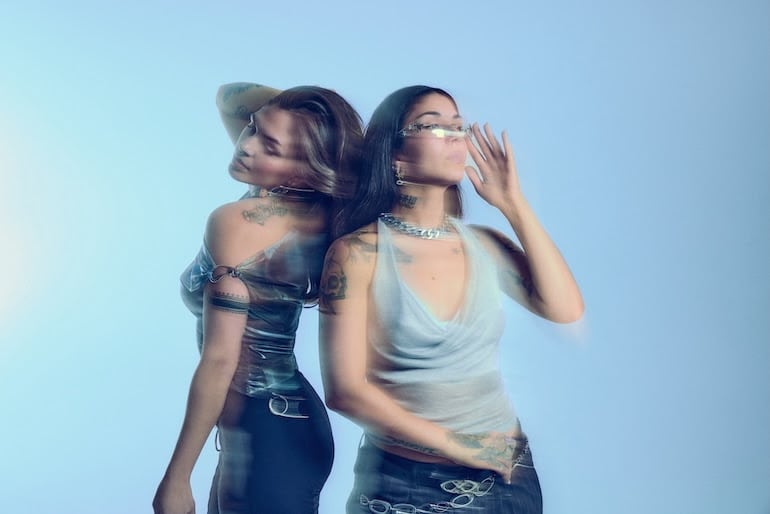
Fifteen years into Krewella, sisters Jahan and Yasmine Yousaf are less interested in proving they have the answers than they are in preserving their ability to keep searching.
That philosophy sits at the heart of “the blueprint,” a volatile collision of hard dance, hyperpop, drum & bass and ethereal electronic pop that captures the contradictions that have always made Krewella difficult to neatly categorize. Released through their independent Mixed Kids Records, the track turns the idea of forging your own path into something both triumphant and uncertain. Going first can mean holding the torch for others, but it can also mean having no idea whether you’re heading in the right direction.
“The loneliest part is when you are unsure whether you actually hold that or not,” Yasmine says. “There is an extreme amount of imposter syndrome that is experienced in trying to produce, write, DJ, take up space in general in this industry.”
That uncertainty feels especially significant coming from artists with Krewella’s history. After breaking through in the early 2010s and spending more than a decade navigating electronic music’s constantly shifting landscape, the sisters stepped away from writing together for nearly two years following 2022’s The Body Never Lies. The distance gave them room to pursue individual creative interests, examine their relationship with success and eventually return to Krewella with a different understanding of what longevity should look like.
For Jahan, that has meant relinquishing some of the pressure surrounding results.
“Letting go of the fixation of chasing so-called career ‘peaks’ has definitely made way for more presence in the process of creating the music, and lightness in our sisterhood as well,” she says.
That renewed perspective runs throughout their fourth album, PEAK. Songs including “Without You,” “Something Sacred” and “the blueprint” translate grief, longing, rage, joy and existential unease into explosive electronic production, turning difficult emotions into something physical enough to move through.
Their independence has become equally important. Since establishing Mixed Kids Records in 2017, Jahan and Yasmine have increasingly operated according to their own instincts rather than an external definition of what Krewella should sound like. For Yasmine, that freedom comes with pressure, but it also creates the conditions for genuine experimentation.
“There isn’t a more expansive way to create than the one where you are the only one calling the shots,” she says.
Perhaps that is Krewella’s real blueprint after all: not a formula to reproduce, but a willingness to remain unfinished.
We spoke with Jahan and Yasmine about authenticity, independence, Pakistani-American identity, imposter syndrome, sisterhood and why surviving 15 years of electronic music might require repeatedly becoming a beginner again.
In conversation with Jahan Yousaf
Authenticity is central to “the blueprint”—the idea of remaining yourself regardless of whether anyone accepts, validates or even notices it. Has your definition of authenticity changed as you’ve gone from teenagers making music together to artists with more than a decade of history behind you?
I think we’ll always have layers to shed that mask our true nature, and that discovery of authenticity is fluid and ever-evolving. I think we both give ourselves more grace now in recognizing that people-pleasing, or acquiescing to what we think other people will want, are all very human parts that exist in us.
We all are growing up in a society that very much validates external image, homogenous beauty standards and quantifiable markers of success, so unlearning this conditioning is a lifetime of work.
I think that’s what makes this idea of “authenticity” exciting, is that it is not a fixed, static state of being; we are constantly obliterating old versions of ourselves to make way for expansion.
You stepped away from both the spotlight and the studio for nearly two years after The Body Never Lies. When you returned to making music together, what creative habits or assumptions about Krewella did you realize you no longer wanted to carry with you?
Prior to our break from writing together, a lot of our studio sessions, and even touring attitudes, were burdened with stress. Obviously some stress is normal, but for myself, I felt an over-seriousness about almost everything Krewella-related.
Creatively, I think my attitude in the studio was often focused on attachment to the outcome of a studio session, how well a song will perform, etc. I feel more mindful of the balance of putting in effort while also sensing when that effort is slipping into the territory of losing the plot, perspective and pleasure of making the music or playing shows.
Letting go of the fixation of chasing so-called career “peaks” (a little nod to our album) has definitely made way for more presence in the process of creating the music, and lightness in our sisterhood as well.
“Without You,” “Something Sacred” and “the blueprint” began suggesting that something larger was taking shape. Now that PEAK is out, what connects these songs emotionally or philosophically, and how do they capture the essence of this era?
Well, by now “K4,” or our fourth album PEAK, is already out! I think these songs you mentioned really capture the essence of the body of work.
They are emotional explosions; a synthesis of the depth, grief, longing, joy, existentialism, escapism and rage that exists in our psyches. We have really enjoyed this art of alchemizing something painful, sentimental or sad into something that can be somatically felt and released in the body through intense and explosive production.
Your Pakistani-American identity has increasingly become part of the artistic conversation around Krewella, particularly on The Body Never Lies. As you’ve grown older, has your relationship with your cultural identity become less about explaining where you come from and more about simply allowing those influences to exist naturally within the work?
I think it’s a little bit of both. Obviously there are cultural influences in our formative years that are embedded in us that are unconsciously expressed in our creative expression without explanation, but I do believe connecting with your ancestral roots does take effort and intention.
Whether that’s learning the language, continuing to make visits to the land itself, connecting with indigenous people who are carrying the traditions forth, listening to the music and learning about the history of the region.
If “the blueprint” is ultimately about creating your own path rather than following one that already exists, after 15 years of Krewella, what territory still feels genuinely unexplored enough to make the two of you feel like beginners again?
I love this question. I have very much been trying to embrace the “beginner’s mind” with many aspects of creativity by remaining a student.
For me personally, I am very inspired by the way Yasmine continues to level up her production craft, and the way she has brought our productions to form. When I witness how she is self-actualizing in real time, I still feel myself in the infancy in the technical aspects of production.
But it inspires me because it shows me what is possible, and how that feeling of “I don’t know how to do this, or achieve this sound!” is part of the process of learning new skills.
I think this beginner’s mind attitude goes beyond creativity though. I think about how to stay in that state even with unlearning history that we’ve been taught through the colonial lens, or surrendering the need to be right in relationships. The beginner’s mind means putting the ego aside and surrendering to not knowing.
In conversation with Yasmine Yousaf
“the blueprint” is described as an ode to people willing to take the lonely path of going somewhere first and holding the torch for whoever follows. After 15 years of Krewella, when have you felt that loneliness of doing things your own way most intensely?
While it has truly been an honor to be called people who “hold the torch” in some ways, the loneliest part is when you are unsure whether you actually hold that or not.
There is an extreme amount of imposter syndrome that is experienced in trying to produce, write, DJ, take up space in general in this industry.
On the flip side of this, having been in the spotlight for 15+ years with an intense touring career under our belts, I can look back and clearly see younger us forging a path that is completely our own and feel such softness for the versions of ourselves that didn’t exactly know what we were doing but doing it anyways.
That version is the reason we are where we are today. Through that confusion, mystery and self-doubt, there was so much alchemy of joy and connection.
Sonically, “the blueprint” almost refuses to settle: ethereal melodies collide with abrasive hard-dance synths, hyperpop vocal chops, euphoric releases and eventually drum & bass. Does that tension between beauty and discomfort reflect something fundamental about the two of you as people as well as Krewella’s music?
While I would love to say that it’s always on purpose, most of the way our music unfolds is completely by accident and part of a discovery process.
I admire musicians who go into the studio and think, “I know exactly how to make what I want to today,” but I can’t say that Jahan and I are always like that. Sometimes we are on a completely blind journey of wandering until it hits.
When it all comes together, you can feel the fusion of all of our past, present and future selves with us, plus our inspirations.
So to answer your question, the process in itself reflects back those states of euphoria and strain and relativity between the two, because that is what it took to create the songs in the first place.
During that break, you explored individual artistic pursuits and personal growth outside the project. When you came back together as sisters, did you have to rediscover your creative relationship with one another?
Absolutely not. I think there has always been a natural creative flow between Jahan and I. While that sometimes has gotten buried under the state of where we were able to show up as in our relationship as sisters and collaborators, at heart we are still the two kids in the basement making weird music together for the love of it.
You chose independence in 2017 and created Mixed Kids Records, meaning you’ve spent much of your career building your own infrastructure rather than fitting into somebody else’s. Has independence made it easier to take risks because there is no longer an external definition of what a Krewella record is supposed to be?
First of all, if you have the courage, means, ability and desire to go independent, we could not recommend it more—desire being the most important word here, because everyone craves something different from their career.
Being the master of your own musical universe can come with an incredible amount of pressure to perform at a level compared to what you did in the past, but if you can move past that arbitrary game of checks and balances, it becomes a true test of how willing you are to be yourself in the face of conformity. A game of free will, so to speak.
That in itself has been such a joy for us as two women who feel like there is somewhat of an untamed beast at the center of our existence. There isn’t a more expansive way to create than the one where you are the only one calling the shots. There is fear, there is depth, and there is huge fulfillment in even the most unknown and terrifying places.
Electronic music has transformed dramatically since you broke through with Play Hard and “Alive,” and you’ve survived several cycles of what the industry considers fashionable. Do you think longevity sometimes requires being willing to disappoint people’s nostalgia for you?
While I would almost knee-jerk to say yes, because obviously there are a handful of people who would like to see us copy-paste the same thing over and over again, I would wager to say that the majority of people want ingenuity from their favorite artists—maybe just cloaked or packaged in a way that they can consume.
Humans are creatures of habit that still crave something brand new. I’d like to think that anyone who has grown with us through our music has been on a journey not only with our songs but themselves; when they’re experiencing a new era of life, we’ve released a new era of music to compose that moment for them.
Nothing is static, and as intoxicating as nostalgia is, there is always something new to replace it if it’s authentic and visceral enough.