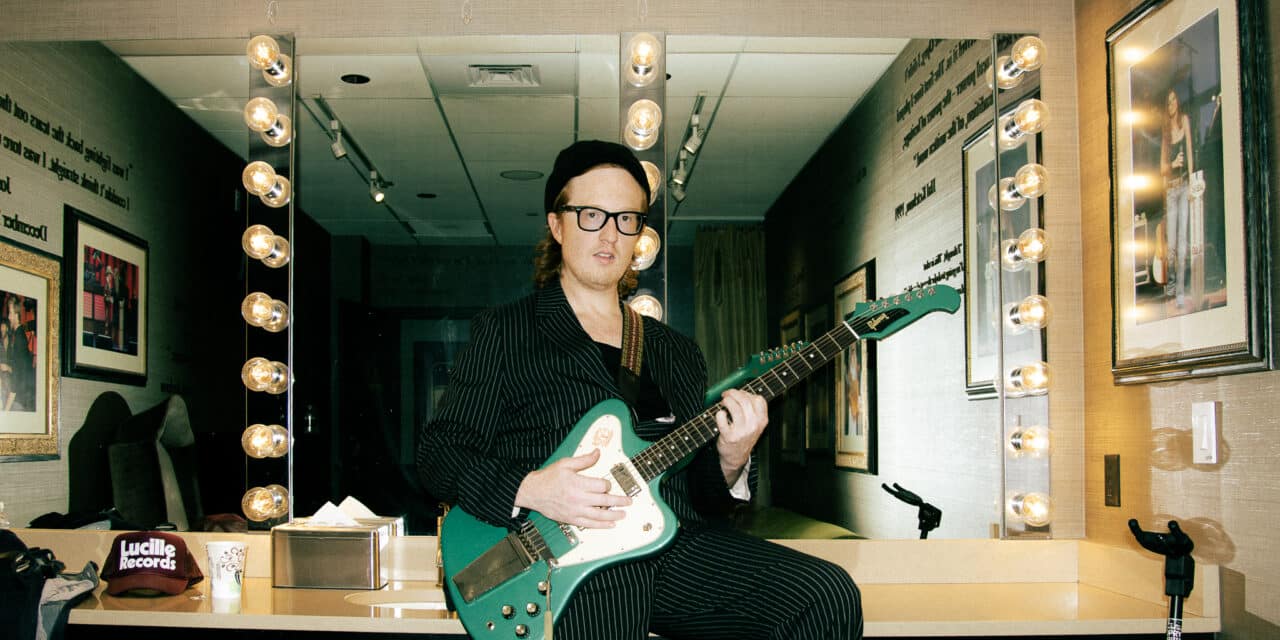
On “Lonely Girl,” the Alabama-born powerhouse brings Chris Stapleton’s songwriting into his own world of Southern rock, R&B and soul—and reflects on Questlove, Dave Cobb, the Grand Ole Opry and why a great vocal should carry some pain
There is something almost old-fashioned about Lamont Landers’ definition of a good song.
Not retro. Not nostalgic. Just fundamental.
It should make you feel something.
“I want to cry, I want to smile,” he says. “I don’t need a 10-second chorus that gets repeated 30 times in a song. Make me feel something.”
That philosophy explains a lot about Landers’ increasingly difficult-to-categorize career.
The Alabama-raised singer moves instinctively between soul, Southern rock, R&B, funk, blues and country, not because genre fusion makes for a convenient marketing narrative, but because those sounds were all present long before he had any reason to think about what category his music belonged in.
His mother introduced him to classic soul. His father brought Southern rock into the house. R&B became, in Landers’ words, “one of the truest loves of my life.”
Now those influences meet on “Lonely Girl,” his latest release through Lucille Records, Dave Cobb’s MCA imprint. Written by Chris Stapleton and Jesse Frasure, the song gives Landers precisely the kind of emotional material he gravitates toward: loneliness, reassurance, yearning, and the possibility that another person might help you survive a difficult night.
“It sort of captures that feeling that we’ve all had—that feeling of being lonely,” Landers says. “Sometimes when you’re in the trenches with those feelings only a good song can pull you out of it. Either that or hold you closely while those feelings wash over you.”
That distinction matters.
Landers doesn’t seem particularly interested in music as emotional decoration. He talks about singing as if it requires entering whatever ache already exists inside a song and allowing the voice to expose it.
“There is a pain in good singing,” he explains. “Not physical, but emotional.”
When that feeling is harder to access, he has another strategy: ask what Otis Redding, Al Green or Bill Withers might have done.
It is an approach rooted in tradition without becoming imitation, and it has carried Landers through an extraordinary series of milestones.
A viral performance of Ray Charles’ “Hit the Road Jack” first showed a young musician with little confidence that audiences might actually want what he had to offer. Later, a cover of The Spinners’ “Rubberband Man” caught the attention of Questlove, whose repost ultimately led producer Dave Cobb to contact Landers.
That connection became a record deal.
Then, in August, another circle closed when Questlove invited Landers to make his Grand Ole Opry debut.
For a singer whose musical universe owes as much to D’Angelo as it does Southern rock, stepping onto one of country music’s most symbolic stages could have felt like crossing into somebody else’s history.
Instead, it became part of his own.
Landers performed with Vince Gill, with his mother, father, fiancée and daughter in attendance.
“Words don’t really come to me for how special that was,” he says.
The moment is another reminder that American musical traditions have always been more intertwined than industry categories often suggest. Soul and country share storytelling. Gospel lives inside both. Southern rock, R&B and blues constantly borrow from the same emotional vocabulary.
Landers simply refuses to pretend those borders are stronger than they are.
Mundane spoke with Lamont Landers about making “Lonely Girl” his own, growing up between soul and Southern rock, his full-circle relationship with Questlove, working with Dave Cobb, the viral video that taught him to believe in himself, and why he would rather take artistic risks than make the obvious record.
Listen HERE
“Lonely Girl” pairs your soulful vocal style with songwriting from Chris Stapleton and Jesse Frasure. What immediately connected you to this song, and how did you make it feel uniquely your own?
It sort of captures that feeling that we’ve all had—that feeling of being lonely. And sometimes when you’re in the trenches with those feelings only a good song can pull you out of it. Either that or hold you closely while those feelings wash over you.
That was my immediate connection to the tune.
Obviously it being penned by Chris Stapleton makes you raise your eyebrows, and it didn’t fail to deliver. It’s a great tune.
As far as making it my own, I think we just approached it the same way we would any song. It has to feel good. I believe we executed fully on that mission.
I’m proud of it.
Your voice effortlessly moves between soul, Southern rock, country and R&B. Do you consciously blend genres, or has your sound naturally evolved from the music that shaped you growing up?
First of all, thank you. I don’t know how effortless it is, but if it comes across that way then I’m doing a good job, I suppose.
It’s not a conscious thing—all of those styles are a part of me and my musical DNA.
Growing up in Alabama, I was certainly exposed to Southern rock, especially with my dad, and R&B has been one of the truest loves of my life. I don’t know why or how, but it has had a grip on me since I was a kid.
My mom exposed me to a lot of the great soul classics from early on and, for whatever reason, it’s always resonated with me.
I think it has been a natural evolution, and fusing these styles has been a byproduct of my upbringing.
I’m very grateful for parents with good taste in music.
Your Grand Ole Opry debut became even more meaningful because Questlove was the person who invited you. What did that moment represent in your journey?
A full-circle moment.
Questlove is directly responsible for me signing my record deal with Dave Cobb. He posted a cover I did of The Spinners’ “Rubberband Man” on his Instagram, leading Dave to reach out, and the rest is history.
This is only compounded by him being one of my favorite drummers of the modern era—and being an architect and the bedrock of my favorite album of all time, Voodoo by D’Angelo, which at this point I could do a dissertation on.
Performing at the Grand Ole Opry itself is one of the highest honors that any musician can aspire to.
Words don’t really come to me for how special that was—performing with Vince Gill with my mom, dad, fiancée and daughter in attendance is something I’ll cherish for the rest of my life.
You’ve now reached audiences through viral moments, streaming platforms, television and iconic live stages. Has your definition of success changed as your career continues to grow?
Certainly—it changes on a month-by-month basis.
I look back on some of the things I’ve done and think, “How in the hell did we get here?”
I never could have imagined playing the Apollo Theater, the Grand Ole Opry, millions of views, touring with Alabama Shakes, the Black Pumas, Gary Clark Jr., St. Paul & The Broken Bones.
But as proud as I am of everything that has happened, I keep my eyes ahead and look for what’s next.
The only measure of success for me that hasn’t changed is this: if you can play music and your bills are paid on time, you’ve done it.
You did the thing that most people pursuing a music career can only dream of.
Dave Cobb has played an important role in introducing your music to the world. What has collaborating with him taught you about trusting your instincts as an artist?
He gives you room to be yourself, but isn’t afraid to let you know if he thinks there are other avenues worth pursuing.
Me and him have this instinctual thing musically where we’ll both reach for the same idea or finish each other’s thoughts before getting them out of our heads.
I love Dave, and I feel like with this record we really hit a stride in our working relationship. I think that shows in the record.
I’m extremely proud of it.
Before the streams and major stages, your cover of “Hit the Road Jack” unexpectedly changed the direction of your life. Looking back, what did that viral moment actually give you?
The length of time from there to here seems like a lifetime.
What it did was show a young kid with low self-esteem and zero confidence that he had a gift that people are willing to receive.
It opened a whole world of opportunities just with that.
I went from shrugging off any idea of a serious music career to believing in myself for the first time in my life.
I’m grateful for that video because it didn’t make me an overnight success, but it did change everything in my life for the better.
Whether you’re singing an original song or interpreting somebody else’s writing, your performances feel deeply personal. How do you emotionally inhabit a song?
I close my eyes and sing.
I’ve always done it that way.
There is a pain in good singing—not physical, but emotional. I tap into that, or try to at least.
When that’s unavailable, I usually think, “What would Otis do here?”
Or Al Green, or Bill Withers.
I try to channel some of my heroes here and there when Lamont is in short supply.
Your music refuses to stay inside one genre. As your profile grows, do you feel more freedom to experiment or more pressure to stay close to what has already worked?
Well, I don’t believe I’ll be diving into heavy metal anytime soon.
But I do want to remain free to explore within the genres that I love—R&B, soul, funk, blues, Southern rock, elements of hip-hop.
They’re all hardwired into me at this point, and at any given moment one or all of them bleed out in one way or another.
If I wanted a sure bet, I’d make a straight retro-soul record, or blues record, or go way more country or Americana.
But sure bets are boring.
I want to be the best me I can be and I hope people come along for it.
Soul music has always been rooted in honesty, resilience and storytelling. What do you think that tradition still has to teach artists working today?
For me, a great song sometimes has so little to do with lyrical content.
I think a lot of songwriters today get focused on the narrative structure of a song, making sure that it checks the boxes for what a song is “supposed” to be without caring a bit about the vibe or the inflection of the vocals.
Soul music threads the needle perfectly.
It delivers a story that does what?
Hits you in the soul.
While singing every note so you feel the pain, the anguish, the excitement, the yearning. All without being cliché or overwritten.
I think that tradition in the modern era is in high demand and in low supply.
I want to feel something when I hear music. I want to cry. I want to smile.
I don’t need a 10-second chorus that gets repeated 30 times in a song.
Make me feel something.
Standing on the Grand Ole Opry stage places you inside a lineage of artists who helped shape American music. When people hear the name Lamont Landers years from now, what do you hope they remember?
With the short attention spans we all have now, I hope worst-case scenario they hear my name and say, “I remember him, he’s pretty good.”
Of course I’d love to have my name uttered among the greats, but I don’t have any delusions when it comes to the reality of the situation.
As long as folks don’t say, “Hey—wasn’t he that guy that fought with Simon Cowell on AGT?”
I’ll be a happy camper.
Landers jokes about legacy, but the thing he appears most serious about preserving is feeling.
Not genre.
Not industry expectations.
Not the safest possible version of his sound.
Feeling.
It is there in the way he talks about loneliness as something a song might not cure, but can at least sit beside you through. It is there in his description of good singing as carrying emotional pain. It is there in his reverence for D’Angelo, Otis Redding, Al Green and Bill Withers—not simply because they were technically extraordinary, but because their voices made experience physical.
And it explains why Landers has little interest in choosing a single lane now that more doors are opening.
A retro-soul album might be easier to explain.
Going fully Americana might be easier to sell.
But Landers seems more interested in following the musical inheritance he actually received: Alabama, Southern rock with his father, soul records with his mother, a lifelong fixation on R&B, and whatever happens when all of those memories enter the studio at the same time.
“Sure bets are boring,” he says.
That might be the most useful description of his career so far.
From a viral Ray Charles cover to Questlove, Dave Cobb, the Apollo and eventually the Grand Ole Opry, Landers has arrived at increasingly iconic places without sanding away the contradictions that got him there.
“Lonely Girl” is another piece of that story—a song written by Chris Stapleton and Jesse Frasure, inhabited by a singer who hears soul music as something much larger than a genre.
For Lamont Landers, the question remains beautifully simple:
Does it feel good?
And more importantly—
does it make you feel anything at all?
“Lonely Girl” is out now via Lucille Records. Lamont Landers continues touring throughout 2026.